Guides
Service vs SaaS vs content, which online business model should you start first?
The short answer
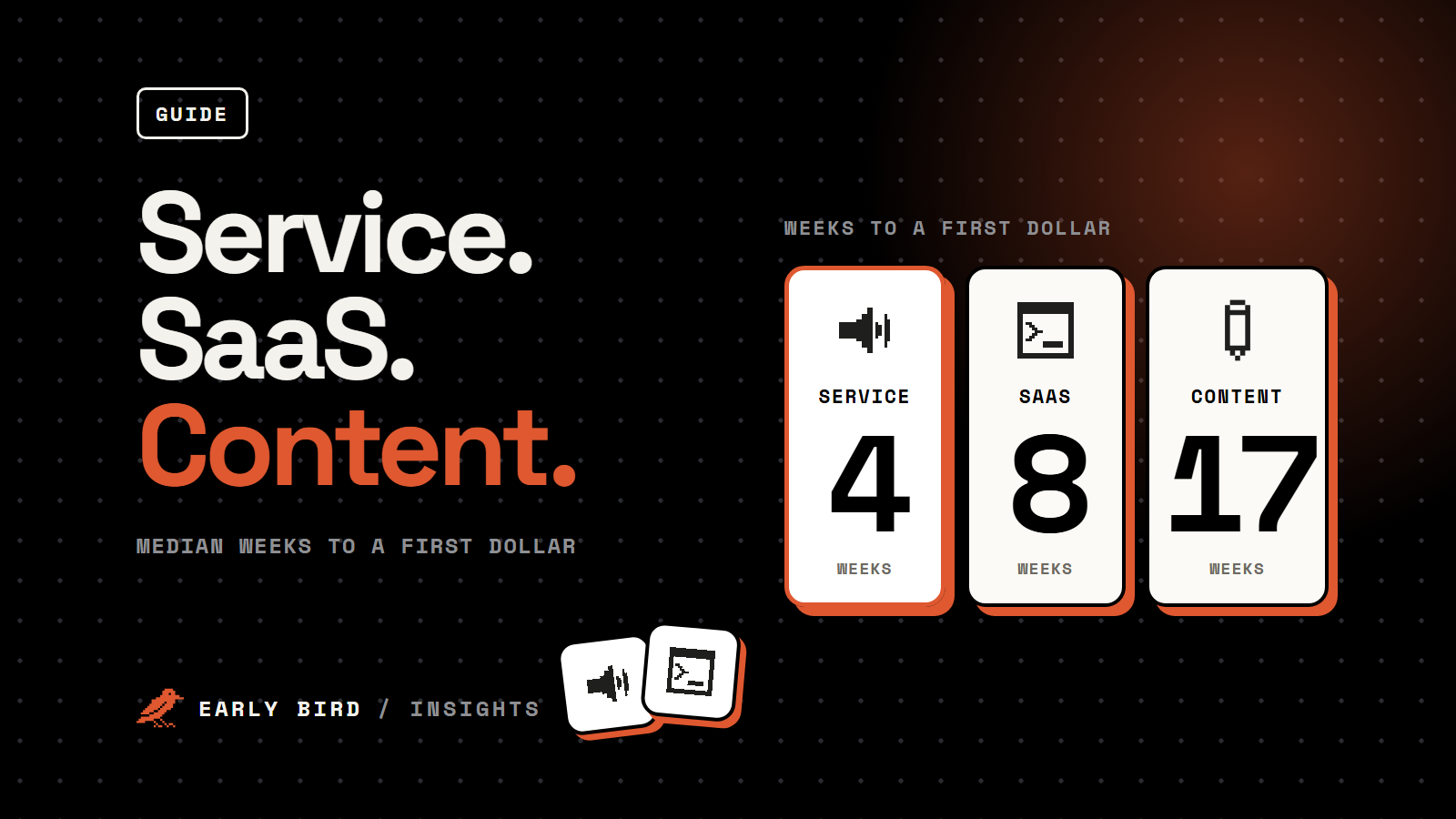
Start with a service if you want a first dollar fast and have a few hours a week. Of 225 service ideas we researched, 70% reach one within four weeks and the median potential is $2,500 a month. Software takes a median of eight weeks and needs coding, while content and newsletters take around 17 weeks. Ecommerce suits beginners with little time.
Key takeaways
- Services reach a first dollar in a median of 4 weeks, ecommerce 6, SaaS 8, and content and newsletters about 17.
- Only 9% of service ideas take longer than two months to reach a first dollar, against 33% of SaaS ideas, 79% of content ideas and 94% of newsletter ideas.
- Services have the highest median potential at $2,500 a month, against $1,500 for each of the other four types.
- Ecommerce is the most beginner friendly, at 82% beginner ideas and 91% needing 10 hours a week or less, while only 3% of SaaS ideas are beginner ideas.
- A type is not destiny: services range from a median of three weeks for an AI receptionist to 13 for a local service website.
Service, software, content or a store: the choice sounds like a matter of taste, but the numbers say it is mostly a matter of what you can afford in time. Some models pay in weeks and some in months, and some need skills most people do not have yet. This is the comparison on one page, then a plain guide to choosing.
The figures come from the 370 ideas researched for the Early Bird board, grouped by business type, and the method is in how we research. We compare the five biggest types, which cover 360 ideas. Apps (6) and marketplaces (4) are too few to compare. Potential figures are estimates, not earnings.
How do the five business types compare?
| Type | Ideas | Median weeks to first dollar | Median potential a month | Under $500 to start | 10 hours a week or less | Beginner ideas |
|---|---|---|---|---|---|---|
| Service | 225 | 4 | $2,500 | 92% | 51% | 23% |
| Ecommerce | 55 | 6 | $1,500 | 89% | 91% | 82% |
| SaaS (software) | 36 | 8 | $1,500 | 100% | 42% | 3% |
| Content | 28 | 17 | $1,500 | 100% | 71% | 54% |
| Newsletter | 16 | 17 | $1,500 | 94% | 94% | 50% |
Cost is not the separator: every type starts under $500 for at least 89% of its ideas. Time is. A service is the only type in which most ideas pay within a month.
When does a service make sense?
When you want money soon and can hold a conversation. Services are 61% of the board, and they win on speed: 157 of the 225 reach a first dollar within four weeks, and only 20 (9%) take longer than two months. They also have the highest median potential, $2,500 a month.
The trade-off is that the business is you. Income is tied to your hours, and the skill asked for most is sales, listed in 42% of service ideas. Only 23% are beginner ideas. Within the type, the range is wide: AI receptionist, social media management, voiceover and AI ad creative services have a median of three weeks, productised and AI automation services four, lead generation six and local service websites 13. See how to get your first client for the outreach side.
When does ecommerce make sense?
When you have little time and no appetite for selling. Ecommerce here means digital products, print on demand and small online stores. Of its 55 ideas, 82% are beginner ideas, 91% need 10 hours a week or less, and 20 need under five. The skill most asked for is basic design, in 65%.
The cost is a lower ceiling. The median potential is $1,500 a month, and the median wait is six weeks. Most of the type is cheap, but niche stores often carry stock or ad costs, which is why 11% of ecommerce ideas need $500 or more. See digital products to sell for the cheapest end.
When does SaaS make sense?
When you can code, can wait about two months, and can put in 10 to 20 hours a week. SaaS has the sharpest skill barrier on the board: 78% of its 36 ideas list coding, only 1 is a beginner idea, and 33% take longer than two months to a first dollar. The median wait is eight weeks.
On costs it looks cheap, with every idea under $500, but running costs begin when you charge. Stripe's Australian pricing page lists 1.65% plus A$0.30 for domestic cards at the time of writing, and Vercel's free Hobby plan is for personal, non-commercial use, with Pro at $20 a month. Its median potential is $1,500, below services, which surprises people. Software scales, but only after the first customers arrive. For details, see micro SaaS ideas by industry.
When do content and newsletters make sense?
When you enjoy making things steadily, you do not need income soon, and you can finish the work without an audience clapping. Both types have a median of about 17 weeks, and 79% of content ideas and 94% of newsletter ideas take longer than two months. About half are beginner ideas, and 94% of newsletter ideas fit into 10 hours a week.
The platforms set the pace. YouTube pays creators only after 1,000 subscribers and either 4,000 public watch hours in a year or 10 million Shorts views in 90 days. On beehiiv, a newsletter platform, you can start free up to 2,500 subscribers, but paid subscriptions need the Lite plan at $49 a month on yearly billing, at the time of writing. Cheap to begin, slow to pay, and the median potential is $1,500 a month. Expect months, not weeks.
How do you decide?
Start from your constraint, not from what looks exciting.
| If this is you | Start with | Why |
|---|---|---|
| You need a first dollar within a month or two | Service | 70% reach one within four weeks |
| You have under 5 hours a week | Ecommerce or a newsletter | 91% and 94% fit in 10 hours or less |
| You can code and can wait two months | SaaS | Needs coding, 8 weeks median |
| You can wait four months and like making things | Content or a newsletter | About 17 weeks median |
| You are a complete beginner | Ecommerce or a simple service | 82% of ecommerce ideas are beginner ideas |
A service is also the best bridge. It brings in money, shows you what customers pay for, and is a common route to a software tool or content later. That sequence is our reading of the data, not a measured result.
What to do next
- Write down your hours a week and the longest you can wait for a first dollar.
- Use the table above to remove any type that fails either test.
- Within what is left, compare models in how long it takes to make money online.
- Check the cost in how much it costs to start an online business.
- Take the 60 second quiz to see ideas matched to your hours, budget and skills.
About this data
Figures cover 360 of the 370 ideas live on 14 October 2026, grouped by the type field we assign to each idea. Types overlap with models: for example, some custom GPT ideas are counted as SaaS, and OpenAI has announced it is retiring custom GPTs. Platform rules were read from official pages on 15 October 2026.
Questions people ask
Which online business model is best for beginners?
In our data, ecommerce is the most beginner friendly: 82% of its 55 ideas are rated beginner, and 91% need 10 hours a week or less. Content and newsletters are about half beginner ideas but slow, at around 17 weeks to a first dollar. Services are faster but only 23% are beginner ideas.
Is a service business better than SaaS?
For speed and for a beginner, usually yes. Services in our research reach a first dollar in a median of four weeks against eight for SaaS, and 70% of them do it within four weeks. SaaS needs coding, with 78% of its ideas listing it, and few are beginner ideas.
How long does a content business take to make money?
About 17 weeks in our data, or four months, for both content channels and newsletters. YouTube, for instance, only pays creators once a channel has 1,000 subscribers and either 4,000 public watch hours in a year or 10 million Shorts views in 90 days.
Can you run an online business with five hours a week?
Yes, but the options narrow. Just 8 of 225 service ideas fit under five hours, against 20 of 55 ecommerce ideas. Ecommerce and newsletters suit small time budgets best, with 91% and 94% needing 10 hours or less. Expect slower progress than the medians suggest.
Can you combine a service with SaaS or content?
Yes, and it is a common path. Selling a service first brings money and customer knowledge, which later shapes a software tool or content. Our estimates cover each type separately, so we cannot say how often the combination works.