Method
How we research online business ideas, and how we estimate what they could make
The short answer
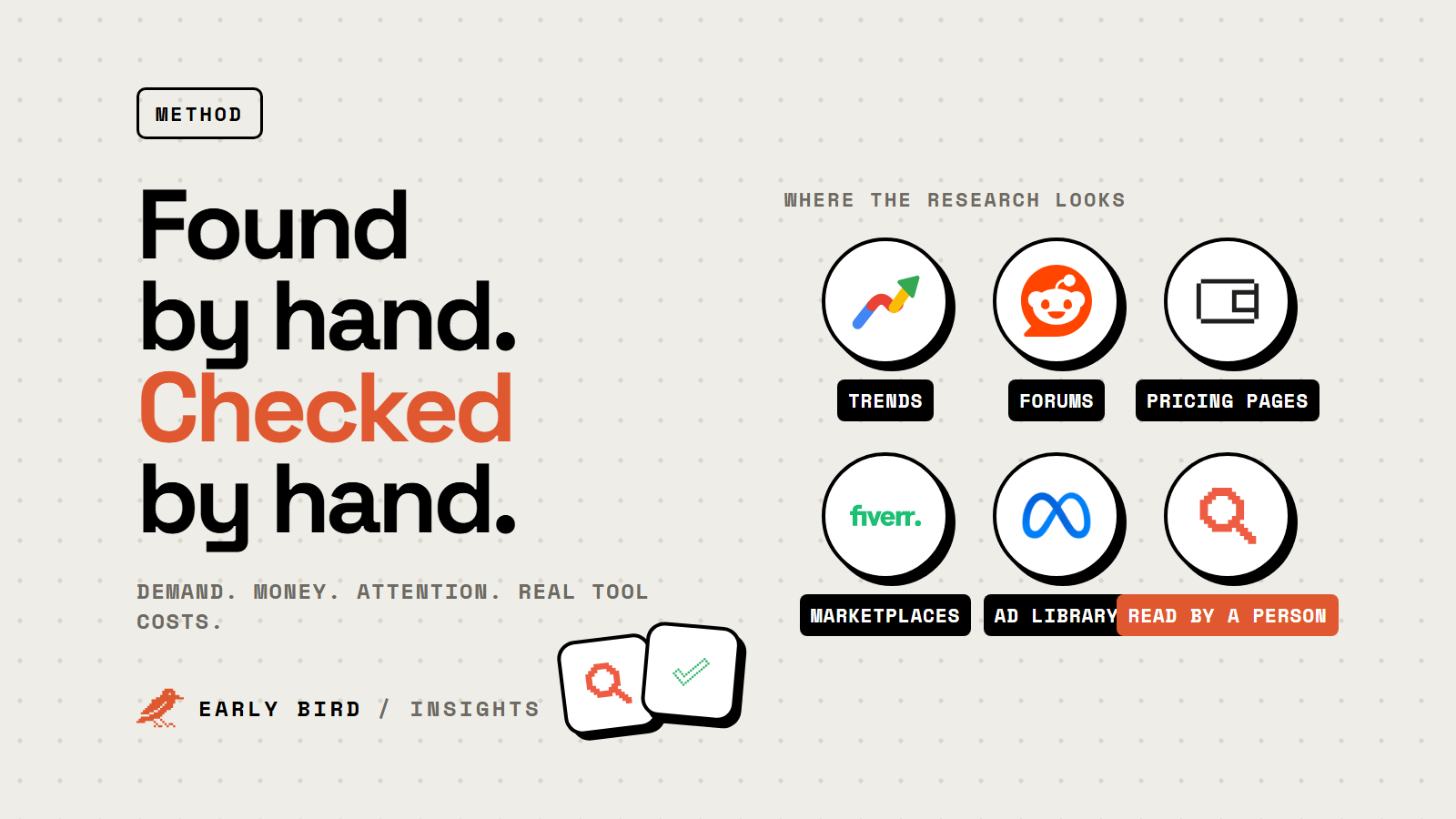
Every idea on the Early Bird board is researched by a person, with AI to help with the reading. Each one needs evidence we could open and check ourselves: people paying for the service now, prices on public pages, and attention over time. The revenue figure is always one sum, a number of customers at one price, and it is a potential, never a promise.
Key takeaways
- Ideas are researched by hand with AI help, then read and approved one by one before they go on the board.
- Every revenue figure is a single sum you can check: this many customers paying this much a month.
- We weigh evidence in a fixed order: demand you can see, money you can see, attention you can see, and real tool costs.
- Anything that needs a licence, sits in a legal grey area or could get an ad account banned is left out.
- The figures are estimates of potential from our own research, not results anyone has been promised.
Every idea on the Early Bird board answers the same three questions before it goes up: is someone already paying for this, what does it cost to start, and what could it realistically make. This page is how we answer them, and what our numbers mean, so you can judge them for yourself.
Who does the research
The board is curated by hand, with AI to help with the reading. That help is real and we say so: an AI assistant searches the web, reads pricing pages and forum threads, and drafts each idea in a fixed format. A person then reads every draft, checks the evidence and decides whether it goes up. Ideas are cut or rewritten at that step all the time.
We think that split is the honest way for a small team to cover hundreds of ideas. The reading is fast. The judgement is the part that matters, and it stays with a person.
What counts as evidence
Every idea needs a reason to believe it, and the reason has to come from somewhere anyone could open and check. We weigh evidence in this order:
- Demand you can see. People paying for the service right now, on job boards and freelance marketplaces, and at what price. Forums and groups where the customer's industry complains about the problem. App store reviews where a tool is loved but missing something.
- Money you can see. Public pricing pages of the businesses already doing it. Founder interviews that include revenue. Listings of small online businesses for sale with their monthly revenue shown.
- Attention you can see. Two years of Google Trends. Who is spending on ads aimed at the customer's industry, from the Meta Ad Library. How recently the model is being talked about.
- Cost you can see. The actual pricing pages of the tools, so the starting cost is right.
There is one firm rule on top: we never cite a source we did not open. If the evidence for a number is not there, the number comes down until it can be defended.
How the revenue figure is worked out
Each idea carries a potential monthly revenue figure. It is always one multiplication: a number of customers, paying one price, each month. If we cannot write that sentence, the number does not go up. Ten business clients paying $300 a month is a potential of $3,000 a month. A digital product is a realistic number of sales a month at its price.
That figure is the size of the opportunity once the business is running. It is not a forecast for you, and it is not what anyone has been promised. Most new businesses take longer than their founder hopes, and plenty never get there. We label the figure as a potential everywhere it appears for exactly that reason.
How the time to a first dollar is estimated
Alongside the revenue, every idea says how long a first payment usually takes. We are deliberately conservative here. Service businesses that sell to other businesses can find a first client in a few weeks, if someone does outreach every day. Content businesses, like a faceless video channel or a newsletter, usually see their first views or readers in days but their first income in months. Across the board, the typical idea reaches a first dollar in about four to five weeks, and one in five takes longer than two months. You can see the full breakdown in what 370 researched online business ideas cost and take.
What every idea includes
Each idea pairs one business model with one industry, because a specific customer is what makes an idea startable. Alongside the revenue and the timeline, it lists:
- the starting cost, in bands from nothing to over $2,000
- the hours a week it needs, from under five to over twenty
- how hard it is, from beginner to advanced
- the skills it needs, and the tools, with what they cost
- a five stage launch plan: proving the idea, deciding what to build, building it, marketing it and launching it, with AI prompts written for that idea
The 60 second quiz uses the cost, hours, skills and goal to show how well each idea fits you.
What we leave out
Some ideas would look exciting on a card and still be a bad thing to hand a beginner. We leave out anything that:
- needs a professional licence or a government scheme
- gives medical, legal or financial advice
- depends on scraping personal data, fake reviews or impersonation
- could get an advertising account banned
We also never describe anything as passive. Every idea on the board takes work, and the plan says how much.
How often the board changes
New ideas go up on a schedule, in a small batch most mornings, once their research is finished. The date an idea was added is shown on every card.
Our limits, plainly
This is research, not advice. The board is a curated sample, so it leans towards ideas we could find evidence for, which means newer and more obscure niches are under-represented. The figures are our estimates and could be wrong. If you think one is, tell us at info@theearlybird.co and we will look again.
Questions people ask
Are the revenue figures what people actually earn?
No. They are our estimate of what an idea could make once it is running, written as a number of customers at one price. Most new businesses take longer than planned and many never reach the figure, so treat it as the size of the prize, not a forecast.
Is the board generated by AI?
No. AI helps with the reading and the first draft, which is how one person can research hundreds of ideas. Every idea is then read, checked and approved by a person before it is published, and anything without evidence is cut or its number lowered.
How often are new ideas added?
New ideas are added on a schedule, in a small batch most mornings. A new idea only goes up once its research is finished, so the pace follows the research rather than a quota.
Why are some ideas left out entirely?
We leave out anything that needs a professional licence, gives medical, legal or financial advice, depends on scraping personal data or sits in a grey area. If it could get a beginner into trouble, it is not an idea we want to hand them.
Can I check the evidence myself?
Yes, and you should. The sources we use are public: job boards, freelance marketplaces, pricing pages, Google Trends and the Meta Ad Library. Each idea's research section says what the evidence was.