Guides
How to get your first client for a local business service, a practical outreach playbook
The short answer
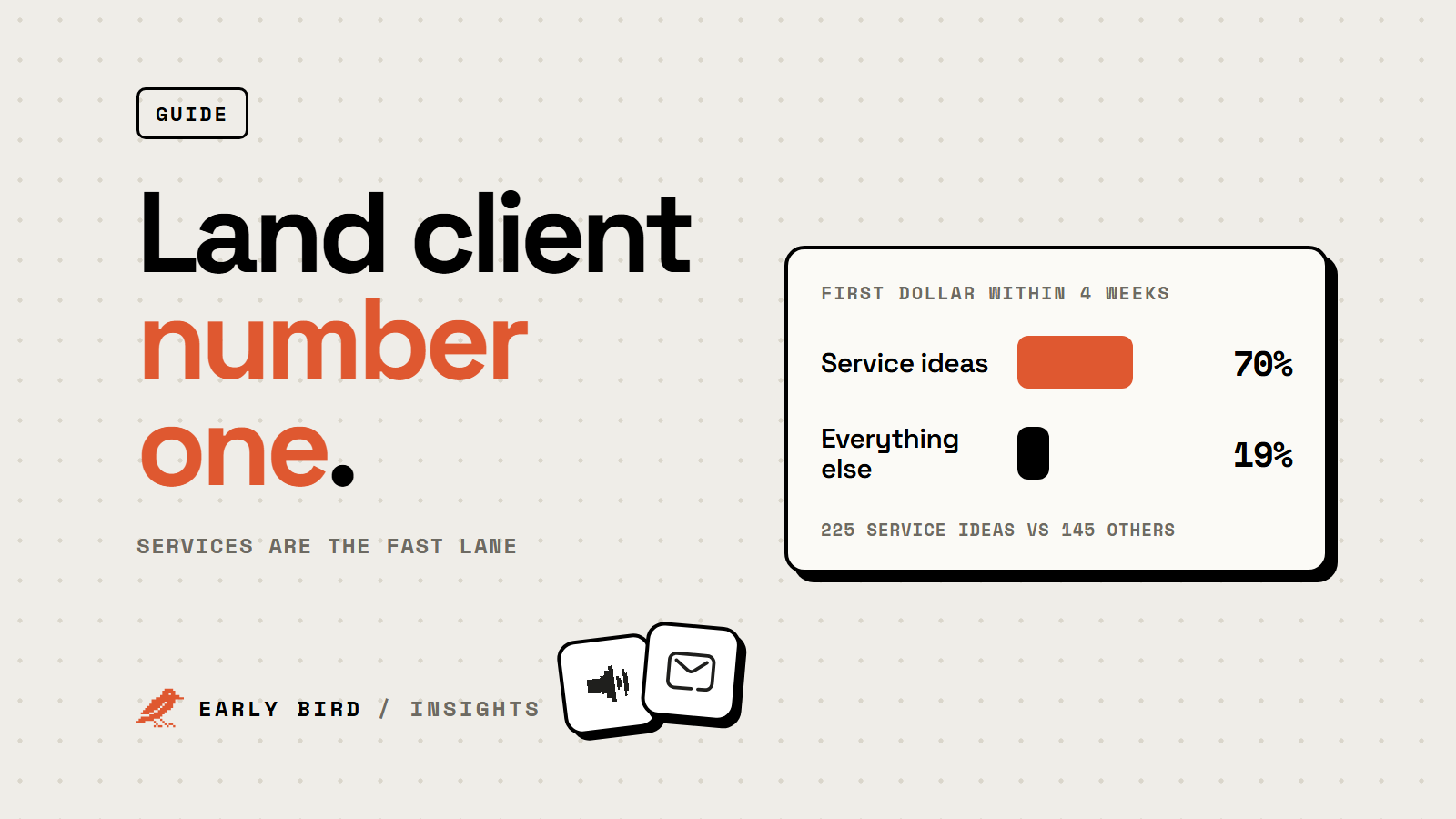
To get your first client, pick one type of local business, contact about fifteen owners a day with a short message about one specific problem you noticed, follow up on days 3, 7 and 14, and offer a small fixed price job first. Of the 225 service ideas we researched, 70% reach a first dollar within four weeks, against 19% of other ideas.
Key takeaways
- 70% of the 225 service ideas we researched reach a first dollar within four weeks, against 19% of the 145 ideas that are not services.
- Services are 61% of the board, 92% cost under $500 to start, and the skill asked for most is sales, in 42% of them.
- The fastest service industries have a median of three weeks, and trades sit at five, so pick your niche with the wait in mind.
- Both US and Australian spam law apply to business email: you must identify yourself, include opt-out and honour it, and Australia needs consent first.
- The four week estimates assume daily outreach, so plan for longer and treat four weeks as a good outcome.
The first client is the hard one. Everything before it, the logo, the website, the tools, is preparation, and a lot of people stay in preparation because it feels safer than asking a stranger for money. This is a plain playbook for the asking: who to contact, what to write, when to follow up and what to offer.
The numbers come from the 225 service ideas among the 370 researched for the Early Bird board, and the method is in how we research. The outreach routine is our own suggestion, not data, and we say so where it applies. Legal points were read from official pages on 15 October 2026 and are not legal advice.
Why go after services first?
Because services are the one kind of business you can sell before you build. Of our 370 ideas, 225 (61%) are services. The data on them is clear:
| Service ideas (225) | All other ideas (145) | |
|---|---|---|
| Median weeks to first dollar | 4 | 9 |
| First dollar within 4 weeks | 70% | 19% |
| Cost under $500 to start | 92% | 95% |
| Beginner ideas | 23% | 48% |
Skills explain the beginner gap. The skill asked for most in services is sales (94 ideas, 42%), then no-code tools (87, 39%) and marketing (64, 28%). Coding appears in only 11. If you can write a clear message and have a conversation, you have the main skill. Most of them also fit a part time schedule: 208 of the 225 (92%) need 5 to 20 hours a week.
Which business should you contact first?
Pick one type, not "small businesses". Our service ideas span 13 industries, and the wait to a first dollar differs:
| Industry (service ideas) | Ideas | Median weeks to first dollar | Reach it within 4 weeks |
|---|---|---|---|
| Fitness | 9 | 3 | 100% |
| Automotive | 13 | 3 | 77% |
| Medical | 15 | 3 | 73% |
| Dental | 11 | 3 | 73% |
| Home services | 16 | 3.5 | 63% |
| Real estate | 15 | 4 | 87% |
| Ecommerce brands | 23 | 4 | 78% |
| Coaches | 22 | 4 | 73% |
| Trades | 26 | 5 | 46% |
Trades is slower in our estimates, possibly because owners are on a job site and slow to answer. That is a reason to follow up more, not a reason to avoid it. The offer matters as much as the industry. Among services, AI receptionist, social media management, voiceover and AI ad creative ideas all have a median of three weeks, productised and AI automation services four, lead generation six and local service websites 13.
How to pick your first 50:
- Choose an industry where you can say what a missed customer costs them.
- Search maps for businesses with weak reviews, no website, or a contact form that never answers.
- Write down one specific observation per business. This is what stops the message sounding like spam.
- Prefer owner run businesses, because the person who reads your message can say yes.
What should the first message say?
Keep it to five lines. This is a template, not a script to paste.
Hi [name], I looked at [business] and noticed [one specific thing, such as calls going to voicemail after 5pm]. I help [type of business] with [one outcome]. I could set up [small thing] for you for [fixed price], and show you how it works first. Would a ten minute call this week be useful? [Your name, your business, your address, how to stop hearing from me]
Why each line is there: the first shows you looked, the second says what you do in plain words, the third is a small offer with a price, the fourth asks for one small step, and the last meets the legal requirement to identify yourself and offer an opt-out.
When should you follow up?
Most replies come after a nudge, so a plan matters. This cadence is our suggestion, not a measured result:
| Day | Action |
|---|---|
| 0 | First message |
| 3 | Short follow-up that adds something new, such as one more observation |
| 7 | Offer a one-line result, such as what you would do in the first week |
| 14 | A polite last message that says you will stop writing |
Then stop. Four touches is persistent, not pushy, and it keeps you inside the opt-out rules. Record every message, who replied and what they said.
For volume, work from assumed rates and replace them with your own. At 15 messages a day for 10 working days you send 150. If 3 in 100 reply, which is an assumed rate and not a benchmark, that is four or five conversations. The point is to measure your real rate in the first two weeks, not to trust a number from a video.
What should you offer first?
The smallest paid thing that proves the result. Three options, in the order we would try them:
- A fixed price pilot with a clear scope, such as one month of a service or one finished deliverable.
- A short demo on their own details, taking you an hour or two, which you show on a call.
- A free audit of one thing, such as their reply time, only if it is quick for you.
Avoid free full projects. They tell the client your work costs nothing, and they use up the hours that the whole idea depends on. Once you have a yes, send an invoice, deliver exactly what you promised and ask whether you may use their result in your next message. Do not invent testimonials. Ask for a real one.
What does the law say about cold outreach?
Two official sources, neither of them legal advice, for email.
United States. The FTC's CAN-SPAM guide says the law makes no exception for business to business email. Your header and subject line must be accurate, the message must be identified as an ad, it must carry a valid postal address and a clear way to opt out, and opt-outs must be honoured within 10 business days. Penalties can be up to $53,088 per email that breaks the rules.
Australia. ACMA says you must have consent before you send marketing messages or emails. Express consent, such as a ticked box, is best practice, and inferred consent applies only where the person knowingly gave their address and would reasonably expect marketing from you. Every message must identify you and include an unsubscribe option that is honoured within five working days.
The practical consequence: consent comes first in Australia, so the safest start is a business that has asked to hear from you or already knows you, not a bulk email to owners you have never dealt with. Calls and texts have their own rules that we have not covered here, so check the rules where you and the business are.
What to do this week
- Choose one industry and write down your offer in one sentence.
- Build a list of 50 businesses, with one observation each.
- Send 15 a day, and put the follow-up dates in a calendar.
- Track messages, replies and calls for two weeks.
- Take your first conversation to a fixed price pilot.
If you do not yet know which service to sell, read how long it takes to make money online, or look at an AI receptionist service and social media management. The 60 second quiz matches ideas to your hours and skills.
About this data
Figures cover the 370 ideas live on 14 October 2026, of which 225 are services. The estimates assume steady daily outreach and are not results anyone has achieved. Legal summaries are general information.
Questions people ask
How do you get your first client with no experience?
Offer a small, fixed price job to one type of local business and show it working on their own details, such as a short demo or a before and after. Contact them directly and specifically. Experience matters less than a clear offer and a message that names a real problem you noticed.
How do you find clients for a small business service?
Choose one industry, list 50 local owner-run businesses, and message about 15 a day by email, a contact form or social media, following up on days 3, 7 and 14. Local searches and map listings show who is missing a website, slow to reply or poorly reviewed.
How many messages does it take to get a client?
It varies too much to give a rule, and we have no data on reply rates. A sensible approach is to track your own: count messages sent, replies and calls for two weeks, then work out how many messages produce one call. Plan from that number.
Is cold emailing businesses legal?
Often, if you follow the rules. The US CAN-SPAM Act applies to business to business email and needs accurate sender details, a postal address and opt-outs honoured within 10 business days. Australia requires consent before sending, and consent can be inferred only in limited cases. This is general information, not legal advice.
Should I offer free work to land a first client?
A small free audit or demo is reasonable if it costs you an hour or two. Free full projects usually teach the client that your work is free. A cheap fixed price pilot with a clear scope is better, because it tests whether they will pay at all.