Guides
Micro SaaS ideas for small business, ranked by industry from 47 researched ideas
The short answer
Across 47 micro SaaS and vibe coding ideas we researched, the median potential is $2,000 a month and the median wait for a first dollar is six weeks, with micro SaaS alone taking about nine. Real estate, trades, ecommerce brands and general business tools rank highest on potential, but each industry holds only two to seven ideas, so treat the ranking as a pointer.
Key takeaways
- Across 47 micro SaaS and vibe coding ideas, the median potential is $2,000 a month and every one costs under $500 to start.
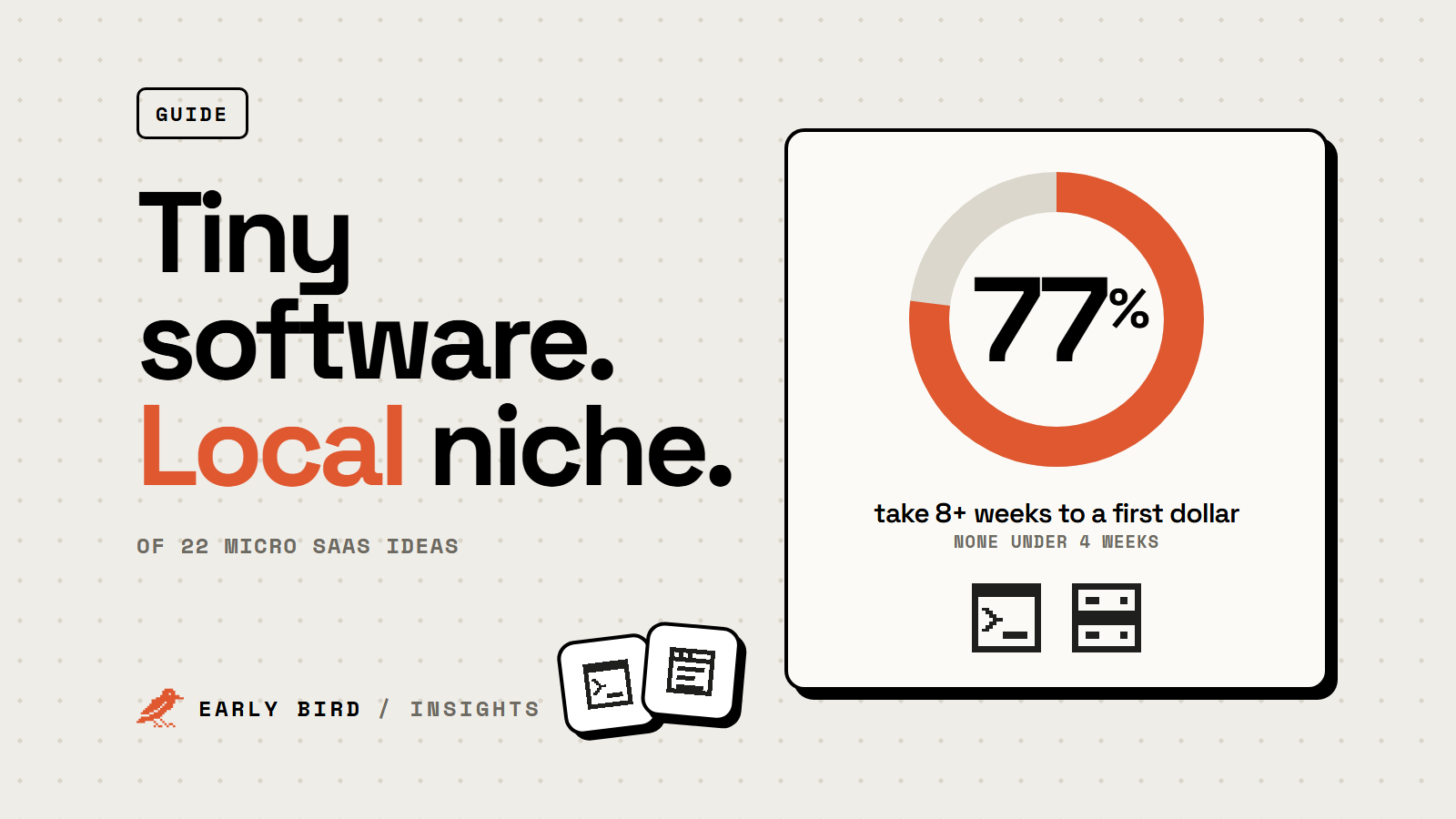
- Micro SaaS alone has a median of about nine weeks to a first dollar. 17 of its 22 ideas (77%) take eight weeks or longer and none reach a first dollar within four.
- 100% of micro SaaS ideas list coding as a required skill, and 7 of the 22 are rated advanced.
- Real estate, trades and ecommerce brands rank highest on median potential, but trades and real estate also take the longest, around 11 weeks.
- Stripe's standard fee on a A$29 domestic payment is A$0.78, or 2.7%, and it rises to A$1.90, or 6.5%, for an international card needing currency conversion.
A list of micro SaaS ideas is easy to write and hard to trust. Anyone can name fifty niches. What is harder to find is which kinds of customer small software tends to pay off for, how long it takes, and what the payment fees do to a cheap subscription. This guide cuts our research by industry, and shows the sums.
The figures come from the 47 micro SaaS and vibe coding ideas among the 370 researched for the Early Bird board, covered in how we research. We never name a specific board idea, so each industry below is described by its figures, with a general illustration of the kind of tool that fits. The revenue figures are estimates of potential, not earnings.
What counts as a micro SaaS idea?
SaaS means software sold as a subscription. Micro means one narrow job for one kind of customer, run by one person. We grouped two models together for this guide: micro SaaS (22 ideas) and vibe coded tools (25 ideas), which are small custom tools built with AI coding assistants. Together they cover 12 of the 13 industries on our board.
Across the 47, the median potential is $2,000 a month and all but one cost under $500 to start, with the other needing nothing. Nearly all need coding: 91% list it as a skill. The tools behind them are consistent, with Stripe in 41 ideas, Vercel in 39 and Supabase in 30. Claude Code appears in every one because we write the plans around it, so it says nothing about the market.
Which 10 industries look strongest for small software?
We ranked industries by median potential, and counted only those with at least two ideas. Home services (two ideas, $1,400) just missed, and medical has a single idea, too few to show. Every industry here holds between two and seven ideas, so a swing of one idea moves the ranking. Weeks are rounded.
1. Real estate (2 ideas)
Median potential $3,250 a month, about 11 weeks to a first dollar, and both ideas need 10 or more hours a week. One of the two is rated advanced. Software here usually handles repeated paperwork, listings and follow-up for agents, who buy on commission and care about time. Only two ideas sit behind this, so treat it as a pointer.
2. Trades (4 ideas)
Median potential $3,000, about 11 weeks, three of four need 10 or more hours a week and two of four are advanced. A typical tool shape is quoting, job scheduling or customer reminders for plumbers and electricians. Trades buyers are slow to trust new software, which fits the long wait.
3. Ecommerce brands (6 ideas)
Median potential $2,750, six weeks, three of six advanced, and only two of six need 10 or more hours. Tools here sit alongside online stores, such as reporting, stock alerts or review handling. It is among the quicker of the higher earning industries.
4. General business tools (7 ideas)
Median potential $2,500, six weeks, two of seven advanced, five of seven need 10 hours or more. The largest group, for tools not tied to one trade, such as simple dashboards or internal utilities. The catch is wider competition.
5. Dental (2 ideas)
Median potential $2,500, about seven weeks, both need 10 or more hours and one is advanced. Practice software is a crowded space with bigger vendors. A small tool has to fit around them, not replace them. Two ideas only.
6. Coaches (4 ideas)
Median potential $2,250, about seven weeks, none advanced, three of four need 10 hours or more. Tools for scheduling, client check-ins and simple programme delivery suit one person businesses that cannot afford larger platforms.
7. Hospitality (6 ideas)
Median potential $2,000, six weeks, two of six advanced, four of six need 10 hours or more. Cafes and restaurants are busy and price sensitive, so tools here tend to handle one job such as bookings or rosters.
8. Fitness (5 ideas)
Median potential $1,500, eight weeks, none advanced, all five need 10 hours or more. Gyms and studios already use booking platforms, so a new tool needs a narrow gap, such as reminders or class reporting.
9. Salons (5 ideas)
Median potential $1,500, about nine weeks, none advanced, three of five need 10 hours or more. Salon owners pay for no-show reduction and rebooking, but they also have established apps to compare against.
10. Automotive (3 ideas)
Median potential $1,500, six weeks, none advanced, one of three needs 10 hours or more. Workshops buy practical tools such as service reminders. The sample is small, so it is the weakest ranking on the list.
Why does software take about two months to pay?
Micro SaaS has a median of about nine weeks to a first dollar. 17 of the 22 ideas (77%) take eight weeks or longer, nine take around 13 weeks, five reach a first dollar within six weeks, and none within four. Vibe coded tools, which can be sold as a one-off project, have a median of five weeks.
Our reading of the data gives three reasons. Building takes longer than a service demo. People pay for software only once it is reliable. And a subscription is a bigger commitment than a one-off job, so owners ask for a trial first. Fourteen of the 22 micro SaaS ideas need 10 to 20 hours a week, so the wait is also the hours it takes to build around a day job.
What do payments cost on a cheap subscription?
Fees matter more on small prices because of the fixed part. At the time of writing (October 2026), Stripe's Australian pricing page lists 1.65% plus A$0.30 for domestic cards, 3.5% plus A$0.30 for international cards, 2% extra when currency conversion is needed, and 0.7% of billing volume if you use Stripe Billing on pay as you go. Rates differ by country, so check your own.
| A$29 monthly payment | Fee | Share of price |
|---|---|---|
| Domestic card | A$0.78 (1.65% = A$0.48, plus A$0.30) | 2.7% |
| Domestic card with Stripe Billing | A$0.98 (adds 0.7% = A$0.20) | 3.4% |
| International card | A$1.32 (3.5% = A$1.02, plus A$0.30) | 4.5% |
| International card with currency conversion | A$1.90 (adds 2% = A$0.58) | 6.5% |
On top of fees, plan for hosting. Vercel's free Hobby plan is for personal, non-commercial use only and its Pro plan is $20 a month, while Supabase's free plan pauses projects after a week of inactivity and Pro starts from $25 a month. We break those running costs down in make money vibe coding.
How to pick an industry
- Start with a customer you can reach. Pick the industry where you can talk to five owners this week, not the highest on the list.
- Check your hours. Most of these ideas need 10 or more a week, so be honest about what you have.
- Choose fast over big if you are new. Ecommerce brands, coaches and hospitality take about six to seven weeks.
- Compare with a service first. If you have no coding skill, service ideas pay faster and teach you what customers want.
To see software and service ideas matched to your skills, take the 60 second quiz.
About this data
Figures cover the 47 micro SaaS and vibe coding ideas live on 14 October 2026, out of 370. Industry groups are small, between two and seven ideas, so medians move with a single idea. Fee and price figures were read from the vendors' pages on 15 October 2026.
Questions people ask
What is a micro SaaS?
It is a small software product, sold by monthly subscription, that does one narrow job for a specific group of customers. It is usually built and run by one person or a very small team. The small scope is the point: it is quick to build and easy to explain.
What are good micro SaaS ideas for small business?
The best ones fix one dull, repeated task for a single kind of business, such as bookings, quotes, reminders or reporting. In our 47 software ideas, real estate, trades and ecommerce brands rank highest on median potential, though each industry has only two to seven ideas behind it.
How long does a micro SaaS take to make money?
In our research the median is about nine weeks to a first dollar, and 77% of micro SaaS ideas take eight weeks or longer. Vibe coded tools sold as projects are faster, at a median of five weeks. Both assume you are talking to customers while you build.
Do you need to code to build a micro SaaS?
Every micro SaaS idea on our board lists coding as a required skill, and 7 of 22 are advanced. AI coding tools reduce the typing, not the judgement needed to test, secure and fix the product. Complete beginners are better off starting with a service.
How much does Stripe charge for subscriptions?
At the time of writing (October 2026), Stripe's Australian page lists 1.65% plus A$0.30 for domestic cards and 3.5% plus A$0.30 for international cards, with 2% extra for currency conversion. Stripe Billing adds 0.7% of billing volume on its pay as you go plan. Rates differ by country.