Guides
Digital products to sell with no audience: 10 types and what each platform takes
The short answer
In our research of 32 digital product ideas, 88% are beginner ideas, 97% need ten hours a week or less and the median is six weeks to a first dollar. The median potential is $1,500 a month, low because each buyer pays once. On a $19 sale the platform's cut ranges from nothing, on Stan's flat $29 plan, to $5.70, so the platform matters.
Key takeaways
- 28 of the 32 digital product ideas (88%) are beginner ideas, and 31 need ten hours a week or less.
- The median is six weeks to a first dollar, and all 32 estimate three months or less.
- The median potential is $1,500 a month, among the lowest of 17 models, because a buyer pays once.
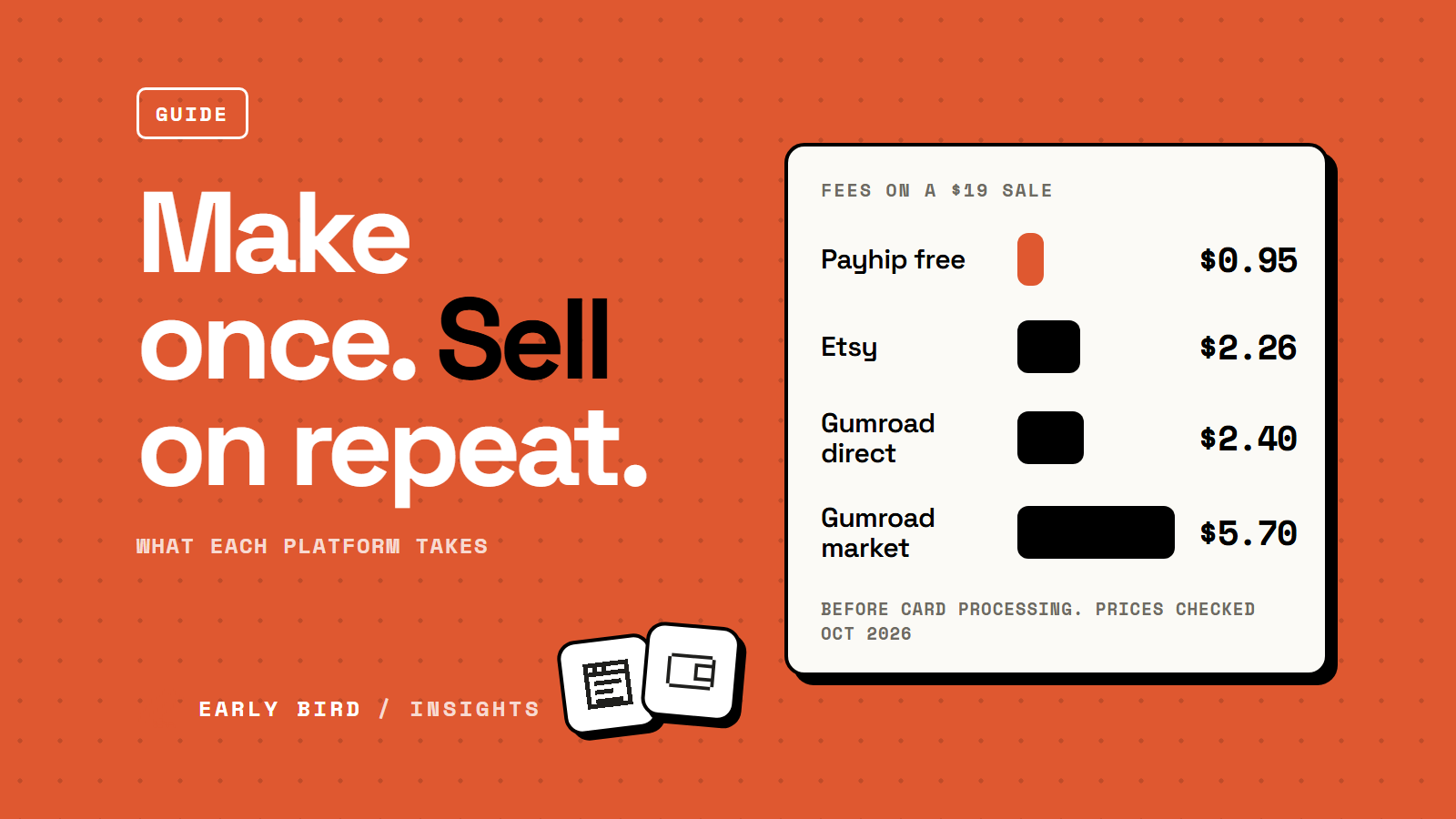
- On a $19 sale, Etsy takes about $2.26, Gumroad $2.40 on a direct sale and $5.70 through its marketplace, and Payhip's free plan $0.95 before processing.
- Etsy asks sellers to disclose AI use in the listing, and the US Copyright Office says prompts alone do not earn copyright.
Digital products are the most common first business for people with no audience and no money, and the most crowded. The question is not what to sell, it is which product type and which platform leave you with money after fees.
We researched 32 digital product ideas as part of 370 online business ideas, and every board figure below comes from them. The revenue figures are estimates of potential, not earnings. How we produce them is in how we research. The product types are our own editorial list, not a count of board ideas, and the platform fees come from each platform's own pages, fetched in October 2026.
What do the digital product ideas on our board look like?
Easy, cheap and small.
| Digital product ideas | Figure |
|---|---|
| Ideas researched | 32 |
| Beginner ideas | 28 (88%) |
| Under five hours a week | 19 (59%) |
| Ten hours a week or less | 31 (97%) |
| Cost nothing to start | 10 (31%) |
| Median weeks to first dollar | 6 |
| Estimate four weeks or less | 6 (19%) |
| Median potential a month | $1,500 |
All 32 estimate a first dollar within three months. The median potential is one of the lowest of the 17 models on the board, for a simple reason: each buyer pays once, so you need a steady flow of new buyers. 31 of the 32 list building an asset as the goal, and only one lists replacing an income.
Design and writing are the skills that come up, in 18 and 16 of the 32. The tools are Canva in 23, Gumroad in 22 and Etsy in 14. We leave Claude out of that count because our plans are written around it. If you would rather sell physical goods made on demand, see is print on demand worth it.
The 10 digital product types, ranked for people with no audience
Ranked by how little trust a stranger needs before buying, from least to most. Products at the top can sell from a search result alone.
1. Spreadsheet and Notion templates
A budget tracker, a client onboarding board, a content calendar. Buyers search by task. The catch: templates are easy to copy, so the niche you pick matters more than the layout.
2. Printables and planners
Worksheets, planners, checklists, wall art. Etsy buyers search for them directly, and they cost nothing to deliver. The catch: huge competition, so narrow niches win.
3. Checklists and playbooks
A one-page process for a specific job, such as onboarding a new client or preparing a property for sale. Fast to make, quick to buy. The catch: low price points.
4. Short guides and ebooks
A 20 to 40 page guide to a narrow problem. The catch: a guide gets judged on its first page, so the specifics have to be real.
5. Industry starter packs
Templates, scripts and checklists bundled for one trade, such as a pack for a plumber's quotes and follow-ups. Specific beats general. The catch: you need to understand the trade.
6. Swipe files and scripts
Email, outreach and sales scripts people can paste and adapt. The catch: buyers see free versions everywhere, so yours needs working examples.
7. Calculators and trackers
A spreadsheet that does one calculation well, such as pricing a quote or tracking a launch. The catch: the maths must be right, or refunds follow.
8. Design assets
Icon sets, social media kits, textures, mockups. The catch: buyers compare quality at a glance, and it needs design skill.
9. Mini courses
A short video or written course on one skill. The catch: trust. With no audience, a course is the hardest to sell and the most time to make.
10. Stock audio, video clips or presets
Assets for other creators. The catch: marketplace rules vary, and volume matters more than any single file.
What does each platform take from a $19 sale?
The same $19 product costs you different amounts on each platform. Prices at the time of writing (October 2026).
| Platform | Monthly fee | Platform takes from $19 | Card processing |
|---|---|---|---|
| Gumroad, direct sale | $0 | $2.40 (10% plus $0.50) | Pricing page does not say |
| Gumroad, found through its marketplace | $0 | $5.70 (30%) | Pricing page does not say |
| Etsy | $0 | $2.26 ($0.20 listing, $1.24 at 6.5%, $0.82 processing) | Included in the $2.26 |
| Payhip Free | $0 | $0.95 (5%) | On top, about $0.85 at Stripe's US rate |
| Payhip Plus | $29 | $0.38 (2%) | On top, about $0.85 |
| Stan | $29 | $0 | On top, about $0.85 |
The Stripe figure is 2.9% plus $0.30, the US rate Stan's help page quotes. Payhip says PayPal and Stripe charge their standard rates on every plan.
The break-even points are worth knowing. Stan's $29 beats Payhip's free plan once you sell about 31 products a month, because the 5% saves $0.95 a sale. Payhip Plus beats Payhip Free at about 51 sales a month. Below that, the free plan is cheaper.
Etsy's 6.5% is charged on the listing price plus delivery and gift wrapping, and listings expire after four months, which costs another $0.20 to renew. Etsy's Offsite Ads fee, 15% for shops under $10,000 a year in sales, only applies when a sale comes through an Etsy-bought ad.
What happens at a lower price?
Fixed fees bite harder on cheaper products. Here is the same sum on a $9 template, with Stripe's 2.9% plus $0.30 at $0.56.
| Platform | Takes from $9 | Share of the price |
|---|---|---|
| Gumroad, direct sale | $1.40 | 16% |
| Gumroad, through its marketplace | $2.70 | 30% |
| Etsy | $1.31 | 15% |
| Payhip Free, with Stripe | $1.01 | 11% |
At $9, the cheapest option takes about a ninth of every sale, and the dearest takes nearly a third. Bundling three $9 products into one $19 pack, rather than selling them singly, cuts the fixed fees you pay per order and raises the average sale. That is a pricing choice, not a growth trick, and it is the kind of change that helps a small shop reach a median potential like our $1,500 a month.
Can you sell AI-made products?
Be careful here. Etsy's creativity standards say sellers must disclose within the listing description if an item was created with AI, and they list AI prompt bundles as not qualifying as designed by a seller. The US Copyright Office's January 2025 report says the mere provision of prompts does not earn copyright, which means a file made purely by an AI tool may be easy for others to copy. Your own writing, arrangement and design on top are what you can protect.
How to choose your first product
- Pick a buyer, not a format. "A plumber's quote pack" beats "a template bundle".
- Start on a marketplace with its own search, so you do not need an audience. Move to your own store once you have repeat buyers.
- Make one product and list it. Six weeks is the median for a first sale, so you learn fast.
- Price above the fee floor. At $19, a platform takes between nothing and $5.70 before card fees, so a $5 product leaves little.
For more on cost, see online business ideas with no money and the under-$500 cut. Or take the 60 second quiz to match ideas to your hours and skills.
Questions people ask
What digital products can I sell with no audience?
Templates, printables, checklists, short guides and design assets are the easiest, because buyers search for them by name on marketplaces such as Etsy. Products that need trust, such as courses, are harder with no audience. In our research, 88% of digital product ideas are beginner ideas.
How much do platforms take from a digital product sale?
At the time of writing (October 2026), Gumroad takes 10% plus $0.50 on direct sales and 30% on sales through its Discover marketplace. Etsy charges $0.20 to list, 6.5% per sale and 3% plus $0.25 payment processing. Payhip's free plan takes 5%, and Stan charges $29 a month with no cut of sales.
How long does it take to make the first digital product sale?
The median across the 32 digital product ideas we researched is six weeks, and all of them estimate three months or less. Only 19% estimate four weeks or less. Product and listing quality matter more than speed of posting.
Can I sell AI-generated products on Etsy?
Yes, with limits. Etsy says sellers must disclose in the listing description if an item was created with AI, and it lists AI prompt bundles as not qualifying as designed by a seller. Separately, the US Copyright Office says prompts alone do not earn copyright, so purely AI-made files are easy for others to copy.
Is selling digital products worth it?
It is a good first business and a modest one. The ideas are cheap and quick to start, but the median potential is $1,500 a month because each buyer pays once. It works best as a first product line or a way to learn selling before a bigger idea.