Data
How long does it take to make money online? Time to a first dollar for 17 business models
The short answer
In our research across 370 online business ideas, the typical one takes four to five weeks to make its first dollar. Services sold to businesses are fastest, around three to four weeks with daily outreach. Software takes about two months, and content businesses such as faceless video channels, newsletters and affiliate sites take around four months.
Key takeaways
- The median time to a first dollar across 370 ideas is four to five weeks.
- AI receptionist, AI social media management, AI voiceover and AI ad creative services are the fastest, at a median of three weeks.
- Micro SaaS takes about two months, local service websites about three.
- Newsletters and affiliate sites take around four months, and faceless video channels around four and a half.
- Speed comes from selling before you build. Anything that needs an audience first is slow, however good the idea.
"How long until it makes money?" is the question everyone asks and almost nobody answers with a number. Here is ours, for 17 online business models, from 370 ideas we researched by hand for the Early Bird board.
Each idea carries an estimate of how long a first payment usually takes, from the evidence we found when researching it. The figures below are the median for each model, so half the ideas take less and half take more. How we make those estimates is set out in how we research.
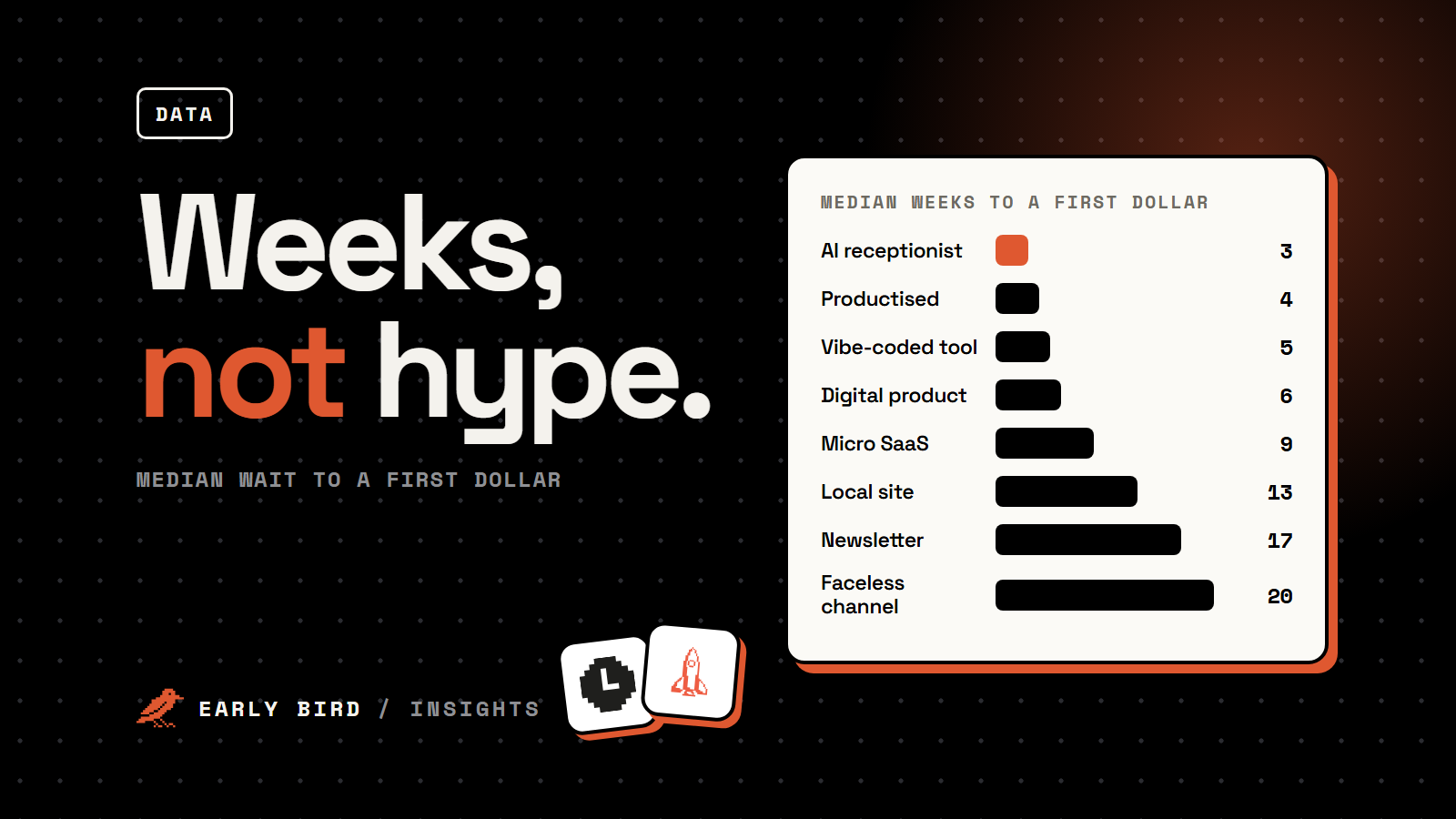
Time to a first dollar, by business model
| Business model | Ideas | Median weeks to first dollar | Beginner ideas |
|---|---|---|---|
| AI receptionist service | 19 | 3 | 16% |
| AI social media management | 15 | 3 | 53% |
| AI voiceover | 13 | 3 | 54% |
| AI ad creative (UGC style) | 12 | 3 | 33% |
| Productised service | 54 | 4 | 35% |
| AI automation service | 46 | 4 | 11% |
| Print on demand | 16 | 4 | 100% |
| Niche online store | 9 | 4 | 22% |
| Custom GPT | 19 | 4 | 11% |
| Vibe-coded tool | 25 | 5 | 4% |
| Digital product | 32 | 6 | 88% |
| Lead generation | 25 | 6 | 0% |
| Micro SaaS | 22 | 9 | 0% |
| Local service website | 21 | 13 | 19% |
| Niche newsletter | 16 | 17 | 50% |
| Affiliate content site | 14 | 17 | 57% |
| Faceless content channel | 12 | 20 | 50% |
Weeks are rounded. A note on the custom GPT row: OpenAI has announced it is retiring custom GPTs in favour of plugins, so treat those ideas with care until the change settles.
Why services are fastest
The four quickest models are all services sold to businesses, and they share one thing: you can sell before you build. An AI receptionist service, for example, can be demonstrated to a dental practice or a plumber on a single call, and a yes on that call is an invoice that week. The tools are cheap and quick to set up, so the bottleneck is finding the first customer, not making the product.
That is also the catch. A three week median assumes you are contacting businesses most days. The estimate is for steady outreach, not for a website left to wait.
Why software takes two months
Micro SaaS and vibe-coded tools sit in the middle. Building a small working tool is faster than it has ever been with AI coding assistants, which is why vibe-coded tools average five weeks. Micro SaaS takes longer, around two months, because people pay for software only once it is reliable, and because subscription products often start with a free trial before the first charge.
Why content takes four months or more
Newsletters, affiliate sites and faceless channels are the slowest models on the board, at four to four and a half months. None of them are slow because they are bad ideas. They are slow because they earn through an audience, and an audience grows a little at a time.
The platforms set hard thresholds too. YouTube only shares revenue once a channel has 1,000 subscribers and either 4,000 watch hours in the past year or 10 million Shorts views in 90 days. YouTube's monetisation rules also exclude what it calls inauthentic content: videos that look made from a template, repetitive uploads and generic AI narration. A faceless channel can still work, but only with original value in every video, and that takes time.
Affiliate sites face their own squeeze, as search engines answer more questions directly. We still include them, with honest timelines, because a genuinely useful niche site earns from readers who trust it.
How to get to a first dollar sooner
Whichever model you pick, the same few habits shorten the wait:
- Sell before you build. Describe the offer and ask ten businesses whether they would pay, before you make anything.
- Pick one customer type. "AI receptionists for dentists" reaches a first client faster than "AI receptionists for everyone", because the message is sharper.
- Do outreach every day. In our estimates, the time to a first dollar for a service assumes steady contact with possible customers. It is the single biggest lever.
- Start on free plans. Most tools have one. Spending early does not buy speed.
- Choose a model that fits your timeline. If you need income this month, do not start with a newsletter, however much you like the idea.
Fast versus big
The quickest ideas are not always the biggest. Across all 370 ideas, beginner ideas have a median potential of $1,500 a month and advanced ones $4,750. The full picture of cost, hours, difficulty and potential is in what 370 online business ideas cost and take. If you are deciding where to begin, the best AI side hustles for a beginner with no money looks at the ideas that are both fast and cheap.
Or take the 60 second quiz to see which ideas fit the hours and budget you actually have.
Questions people ask
What is the fastest way to make money online?
In our data, selling a service to businesses is fastest: AI receptionists, AI social media management, AI voiceover and AI ad creative all have a median of three weeks to a first dollar. The speed depends on outreach, so expect that only if you are contacting businesses every day.
How long does it take a faceless YouTube channel to make money?
Around four and a half months in our research, and often longer. YouTube only pays creators once a channel has 1,000 subscribers and either 4,000 watch hours in a year or 10 million Shorts views in 90 days, and templated, mass-produced videos are not eligible at all.
How long does a newsletter take to make money?
About four months in our data. A newsletter usually earns through sponsors or paid subscriptions, and both need a few thousand engaged readers first. The tools are cheap: beehiiv, for example, is free up to 2,500 subscribers.
Why do service businesses make money faster?
Because you can sell before you build. One conversation with a business owner can become an invoice the same week, while a content business has to build an audience before anything can be sold to it.
Is four weeks to a first dollar realistic for a beginner?
It can be, for a service idea, if you treat outreach as the job. Our estimates assume steady effort most days. Most people underestimate how long finding the first customer takes, so plan for longer and treat four weeks as a good outcome, not a promise.