Guides
Side hustles for graphic designers: 6 online business ideas ranked by speed to a first dollar
The short answer
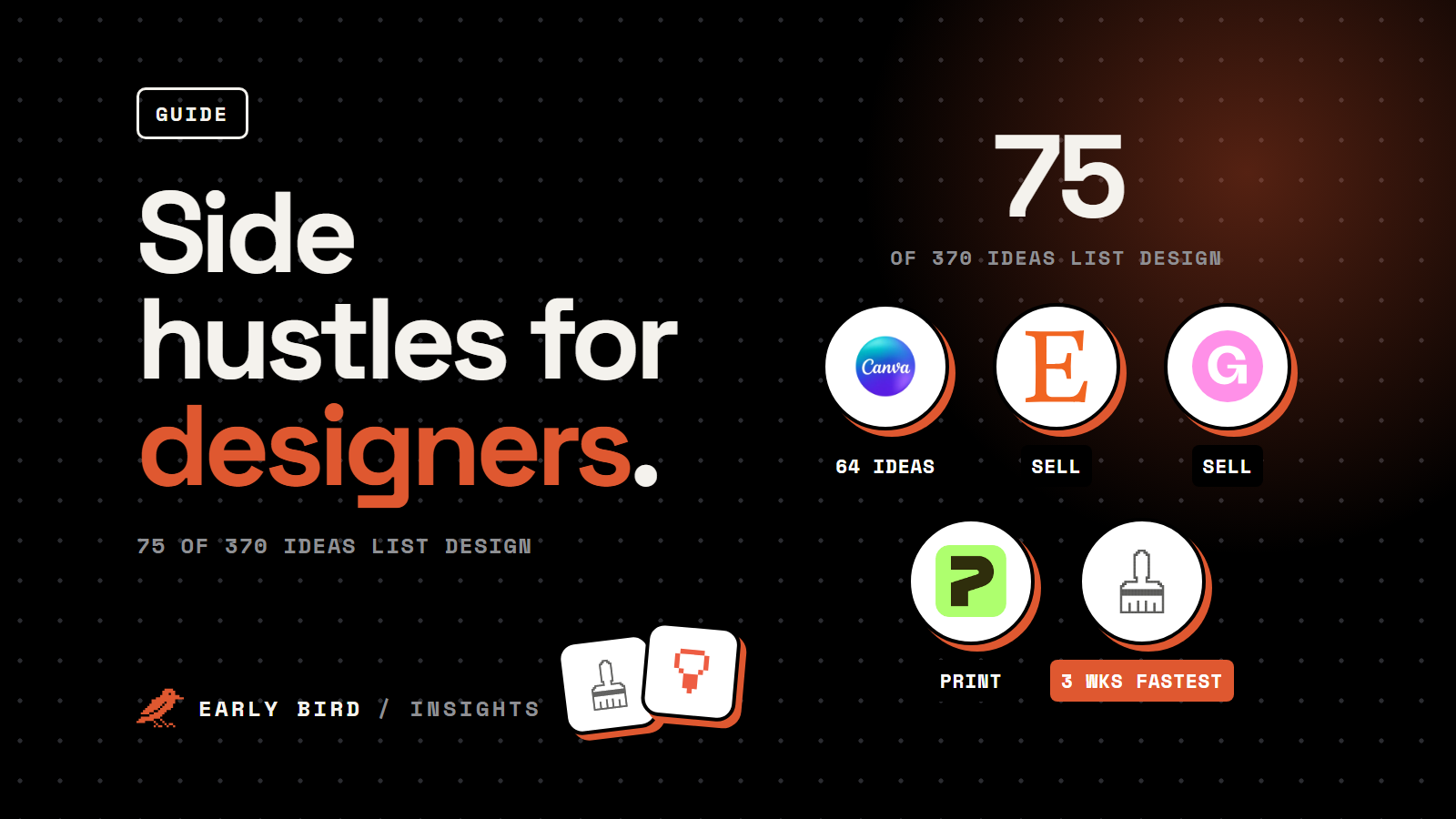
75 of our 370 researched online business ideas (20%) use design skills. Social media management and productised design services are fastest, at a median of three weeks to a first dollar. Digital products and print on demand are the most beginner friendly but cap lower, at a median potential of $1,500 a month, an estimate and not an earning.
Key takeaways
- 75 of 370 ideas (20%) list basic design as a skill, and 76% of those are beginner ideas.
- The median design idea takes four weeks to a first dollar and has a potential of $2,000 a month.
- Social media management and productised services are fastest, at three weeks, and have the highest potential, $3,000 and $2,750.
- Digital products and print on demand are 100% beginner ideas, but have the lowest potential of the group, $1,500 a month.
- On Gumroad a $9 sale loses 15.6% to fees and a $29 sale 11.7%, so price decides how much you keep.
If you can design, you already have the hardest part of several online businesses. The question is which of them rewards it, and how quickly. Most lists for designers stop at "sell templates" and "do logos", which is where everyone already looks.
We cut our board of 370 online business ideas, researched by hand, to the ones that list design as a skill. The numbers below come from that cut. The revenue figures are estimates of potential, not earnings, and how we research explains the sums. A note on scope: the board tags a skill called basic design, so the figures describe a competent beginner, and a trained designer can aim higher.
Which online business ideas use design skills?
75 of the 370, one in five, list basic design. None are custom GPT ideas. They are cheap and approachable: 74 cost under $500, nine cost nothing, and 57 (76%) are beginner ideas. The median takes four weeks to a first dollar and has a potential of $2,000 a month.
Two features set them apart. First, 64 of the 75 use Canva, which makes the tool cost the main cost. Second, 44 need design as their only skill. The rest pair it with another: 17 with writing, eight with marketing and seven with selling. Hours are modest: 56 of the 75 need ten hours a week or less.
What are the 6 best design side hustles, ranked?
We grouped the 75 by business model and kept the six with at least five ideas. The ranking is by median weeks to a first dollar, with ties broken by median potential. Voiceover and niche stores, with three ideas each, and a single vibe-coded idea are too small to rank.
1. Social media management
Eleven ideas, three weeks, $3,000 potential, 64% beginner, none list selling. Branded post templates, a posting schedule and a fixed monthly fee. The catch: you need a regular client, and consistency is the job.
2. Productised design service
Twelve ideas, three weeks, $2,750 potential, 75% beginner. One defined result at a fixed price, such as a pack of assets. Our guide to productised services shows how to scope and price one. The catch: you must find each client yourself.
3. Ad creative
Six ideas, about three to four weeks, $2,500 potential, 50% beginner. Short product videos and static ads for small brands. The catch: it moves into video editing, and buyers judge you on ad results.
4. Print on demand
Fifteen ideas, four weeks, $1,500 potential, 100% beginner, five cost nothing. Designs on products that a partner prints and ships. The catch: the lowest potential in the group and a very crowded market.
5. Digital products
Eighteen ideas, six weeks, $1,500 potential, 100% beginner, three cost nothing. Templates, planners and asset packs made once and sold repeatedly. The catch: nobody finds them by accident, so you need a way to be seen.
6. Faceless content channel
Six ideas, about 17 weeks, $1,750 potential, 50% beginner. Design-led video with no one on camera. The catch: it is a months-long project before the first dollar.
| Model | Ideas | Weeks to first dollar | Median potential a month | Beginner share |
|---|---|---|---|---|
| Social media management | 11 | 3 | $3,000 | 64% |
| Productised design service | 12 | 3 | $2,750 | 75% |
| Ad creative | 6 | 3.5 | $2,500 | 50% |
| Print on demand | 15 | 4 | $1,500 | 100% |
| Digital products | 18 | 6 | $1,500 | 100% |
| Faceless content | 6 | 17 | $1,750 | 50% |
How many hours go in before the first dollar?
Weeks are a poor way to compare, because a week of a part time hustle is not a week of full time work. Hours are better. 44 of the 75 design ideas need five to ten hours a week, 12 need under five and 17 need ten to twenty.
Take eight hours a week, the middle of the commonest band, and multiply by the median weeks to a first dollar. Social media management and a productised service, at three weeks, are about 24 hours before the first payment. Print on demand, at four weeks, is 32 hours. Digital products, at six weeks, are 48. A faceless channel, at about 17 weeks, is 136 hours. These are illustrations of the maths, not promises, but they show why a designer short on time should start with a service, and a designer short on money should expect to pay in hours.
What do the fees actually take?
Product ideas lose a slice of every sale, so price matters. At the time of writing (October 2026), Gumroad charges 10% plus $0.50 per sale through your own links, with no monthly fee. Here is what that leaves:
- A $9 template: $0.90 plus $0.50 is $1.40, or 15.6%, so you keep $7.60.
- A $29 pack: $2.90 plus $0.50 is $3.40, or 11.7%, so you keep $25.60.
- If a buyer finds you through Gumroad's Discover marketplace, the fee is 30%.
For services, Stripe's standard online card fee in Australia is 1.65% plus A$0.30 for domestic cards, and 3.5% plus A$0.30 for international ones. The small fee matters less than the price you set.
Is design still worth selling in an AI age?
Honest answer: it is changing, and every plan on our board assumes AI is part of the workflow. Canva appears in 64 of these 75 ideas, which tells you the work is template and tool based, not hand drawn. We do not claim to know where the market for design settles.
What the data does show is that the ideas seem to pay for judgement more than for making. Social media management and productised services, where you decide what a client needs, are faster and pay more than selling a finished asset to strangers.
How should a designer choose?
- Need money soon? Start with social media management or a productised service. Both reward design and a few conversations.
- Prefer to make once? Choose a digital product or print on demand, and accept six weeks or more.
- Do you write too? 17 of the 75 pair design with writing. See side hustles for writers, and side hustles for introverts if selling is the sticking point.
Or take the 60 second quiz and the board will sort to your skills, hours and budget. For the wider picture on cost, see online business ideas under $500.
Questions people ask
What are the best side hustles for graphic designers?
In our research, social media management and productised design services are fastest, with a median of three weeks to a first dollar. Digital products and print on demand suit people who would rather make something once and sell it repeatedly, but they pay slower and cap lower.
Can graphic designers make money with print on demand?
It is possible, and print on demand is a 100% beginner model in our data, with a median of four weeks to a first dollar. The ceiling is low, with a median potential of $1,500 a month, and niches are crowded, so a narrow audience matters more than polish.
How much does it cost a designer to start an online business?
Very little. 74 of the 75 design-based ideas cost under $500 and nine cost nothing. Canva is free, with Pro at US$144 a year at the time of writing (October 2026). A designer who already owns professional software may need nothing extra.
Do I need to be a professional designer for these ideas?
No. The ideas ask for basic design, and 85% of them use Canva. If you are a trained designer, you can aim higher than the typical idea, but our figures describe what a competent beginner could do, not the ceiling for a specialist.
Is selling digital products worth the fees?
Often, yes, because there is no monthly cost. Gumroad charges 10% plus $0.50 a sale at the time of writing, so a $9 product loses $1.40, or 15.6%, and a $29 product loses $3.40, or 11.7%. Sales that come through its Discover marketplace cost 30%.