Opinion
Is affiliate marketing worth it in 2026? AI answers, commission rules and our data
The short answer
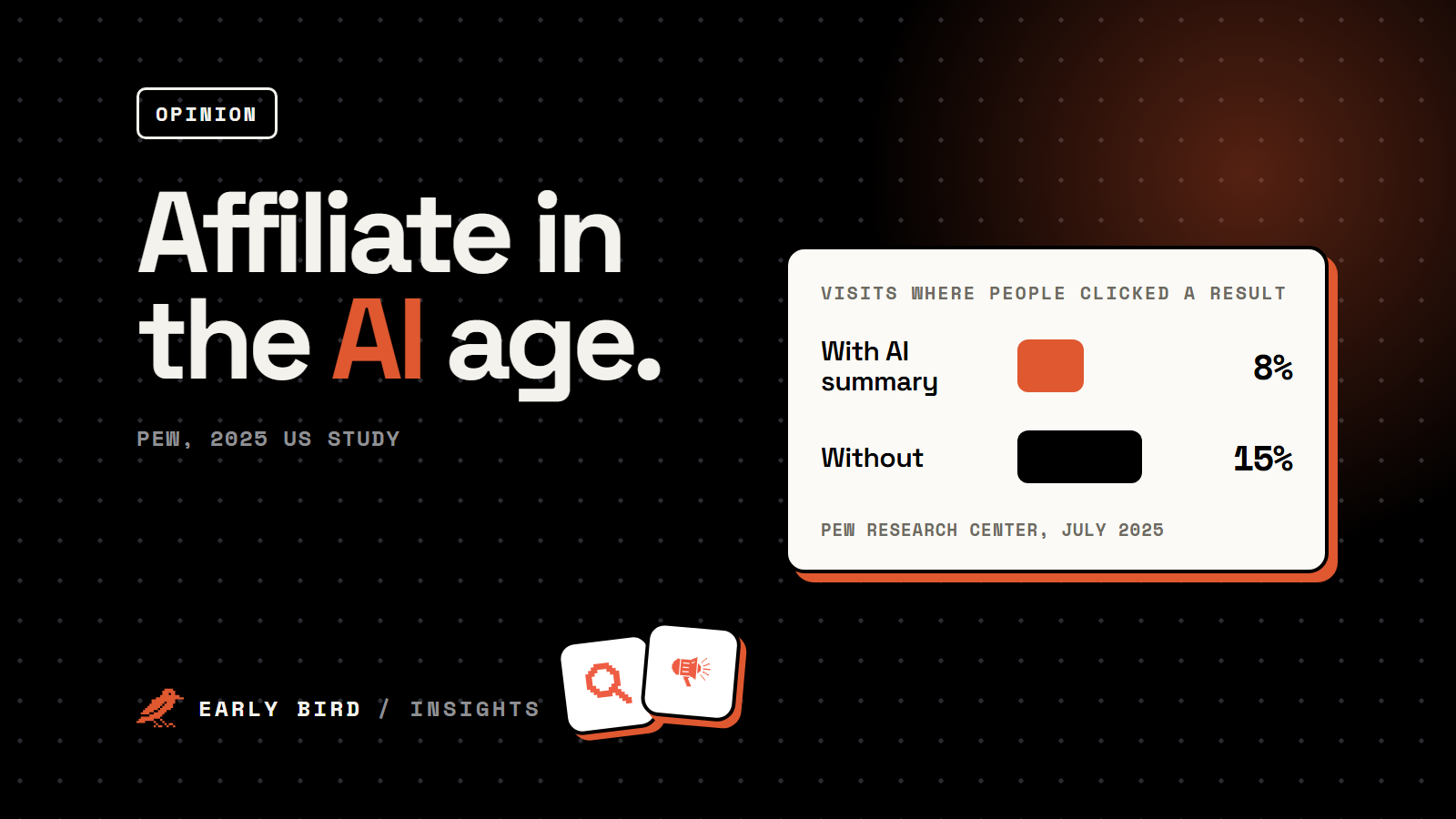
Affiliate marketing is worth it only as a slow, small content asset. In our research of 14 affiliate content ideas the median potential is $1,000 a month, the lowest of 17 models, and the median is 17 weeks to a first dollar. Pew found people click a result link in 8% of Google visits with an AI summary against 15% without.
Key takeaways
- The median affiliate content idea on our board has a potential of $1,000 a month, the lowest of the 17 models, and takes 17 weeks to a first dollar.
- 9 of the 14 estimate four months or more, and none estimates under four weeks.
- Pew found people clicked a traditional result link in 8% of Google visits with an AI summary and 15% without, in a 2025 US study.
- At a 3% commission, $1,000 a month needs about $33,000 of purchases through your links. At 8% it needs $12,500.
- The FTC says affiliate disclosure must sit close to the recommendation, and the words affiliate link alone are not enough.
Affiliate marketing has the best pitch in online business: recommend things, get paid when people buy. It also has one of the slowest starts, and search is changing under it. Here is what our data and the official rules say.
We researched 14 affiliate content ideas as part of 370 online business ideas. The board figures come from them, and the revenue numbers are estimates of potential, not earnings. The method is in how we research. The external facts come from Pew, Amazon and the FTC, fetched in October 2026.
What does our data say about affiliate marketing?
It is the smallest and slowest model on the board.
| Affiliate content ideas | Figure |
|---|---|
| Ideas researched | 14 |
| Median potential a month | $1,000 |
| Median weeks to first dollar | 17 (about 4 months) |
| Estimate four months or more | 9 (64%) |
| Estimate under four weeks | 0 |
| Beginner ideas | 8 (57%) |
| Cost under $500 to start | 12, plus 2 that cost nothing |
| Ten hours a week or less | 12 (86%) |
Every one of the 14 needs no coding, and writing is the main skill, named in 10. Google Search Console is in 9 of the ideas, Webflow in 8 and Canva in 5, and we leave Claude out of that count because our plans are written around it. None lists replacing an income as a goal, and 12 of the 14 list building an asset.
Affiliate content has the lowest median potential of all 17 models. We still research it, because it is cheap and a useful niche site does earn, but nobody should call it a fast route.
Has AI search changed the maths?
It has changed the traffic. In July 2025 the Pew Research Center reported on 900 US adults whose browsing it tracked in March 2025, covering 68,879 Google searches. When a search showed an AI summary, people clicked a traditional result link in 8% of visits. When it did not, they clicked in 15%. Clicks on links inside the summary were about 1%.
Two cautions. It is one US panel at one point in time, and it measured Google only. But the direction is plain: for the same ranking, an affiliate page earns fewer visits when an AI summary sits above it.
What that means in practice:
- Own the audience. An email list or a community does not depend on a result page.
- Add what a summary cannot. Photos, tests, prices you checked and a view you can defend.
- Aim at decisions. Comparisons and "which one for me" pages answer questions a summary answers badly.
Which affiliate ideas do best on our board?
Within a small group the differences are small, and with 14 ideas they are hints, not rules. Split by difficulty:
| Affiliate content ideas | Ideas | Median weeks to first dollar | Median potential a month |
|---|---|---|---|
| Beginner | 8 | 15 | $1,000 |
| Intermediate | 6 | 22 | $1,500 |
The harder ideas pay a little more and take longer, which fits the pattern across the whole board: more effort, higher potential. By hours, 9 of the 14 need five to ten hours a week and 3 need under five. Nobody on our board needs to spend a fortune to start, with 12 of the 14 under $500 and 2 at nothing. The cost is not money, it is the months before the first sale.
One more reading of the table: the beginner ideas are not the poor relation. They reach a first dollar about six and a half weeks sooner, so they are the sensible place to learn how search, trust and links actually work.
How do commissions actually work?
Take Amazon Associates as the example. Its Commission Income Statement says a purchase counts when, within 180 days, the product has been shipped, streamed or downloaded, and paid for by the customer. A shopping session starts at the click and ends at the first of several events, including 24 hours elapsing, and an order can still count if the customer adds the item to their cart and buys within 89 days of the click. Standard commission income is set in a separate schedule, which sits behind a login, so we cannot verify and do not print a rate.
So here is an illustration with made-up rates. The $1,000 median potential needs this much in purchases through your links:
| Commission rate | Purchases needed | Orders at $50 each |
|---|---|---|
| 1% | $100,000 | 2,000 |
| 3% | $33,333 | 667 |
| 8% | $12,500 | 250 |
That is the question to ask of any programme: at its rate, how many sales a month does the number you want need?
A fair question is whether this makes affiliate marketing pointless. It does not, but it moves the work. A page that only repeats what a summary already says has little reason to exist. A page with something original, such as your own test results or a comparison of prices you checked this month, still gives a reader a reason to click through, and a newsletter or community lets you reach the same readers without a search result in between.
What must you disclose?
In the US, the FTC says that if you earn commissions through affiliate links, you must disclose that relationship clearly and conspicuously, close to the recommendation. Its guidance says the words affiliate link alone are not enough, because people may not understand that the person posting the link gets paid. A plain statement such as "I get commissions for purchases made through links in this post" works. In videos, disclose in the video and near the links in the description. Other countries have their own rules, so check yours.
So is affiliate marketing worth it?
Worth it if three things are true:
- You can write something good. A useful niche site is a long project.
- You can wait. Plan for four months before any income, and more before it matters.
- You treat it as an asset. It suits a side project, not a replacement for work.
If you need a first dollar this month, a service is faster: our timeline data puts services at around four weeks. If you like the writing side, a niche newsletter is a similar asset with a direct audience, and faceless YouTube has the same slow shape.
Before you commit months to a site, check four things:
- The rate. Read the programme's own commission schedule and run the sum above with it.
- The window. Find out how long a click counts, as Amazon's statement does.
- The rules. Read the programme's policies on links, disclosure and where you can place them.
- The reader. Name who you are writing for, and what they would otherwise search.
What to do next
Before you build a site, pick one niche and one programme, and run the sum above with its real rate. Then see where affiliate sits against everything else in what 370 ideas cost and take, or take the 60 second quiz and let the board filter by your hours.
Questions people ask
Is affiliate marketing still worth it in 2026?
It is worth it as a slow content project, not as a quick income. Our 14 researched affiliate ideas have a median potential of $1,000 a month and a median of 17 weeks to a first dollar. AI summaries in search are also reducing clicks, which makes a direct audience more valuable.
How much does affiliate marketing pay?
It depends on the programme and the commission rate. As an illustration with made-up rates, a 3% commission needs about $33,333 of monthly purchases through your links to reach $1,000, and 8% needs $12,500. Check each programme's own rate schedule before you plan around it.
How long does affiliate marketing take to make money?
In our research the median is 17 weeks, about four months, and 9 of 14 estimate four months or more. None estimates a first dollar within four weeks. A new site has to be found, trusted and read before anyone buys.
Do AI search answers hurt affiliate sites?
Probably, though the research is early. A 2025 Pew Research Center study of 900 US adults found people clicked a traditional result link in 8% of Google visits that showed an AI summary, against 15% without one. It measured Google only.
Do you have to disclose affiliate links?
Yes. The US Federal Trade Commission says you must disclose a financial relationship clearly and conspicuously, close to the recommendation. It says affiliate link alone is not enough, and that a plain statement such as I get commissions for purchases made through links in this post works.