Guides
Niche newsletter ideas: 10 niches ranked by how they earn, from leads to sponsors
The short answer
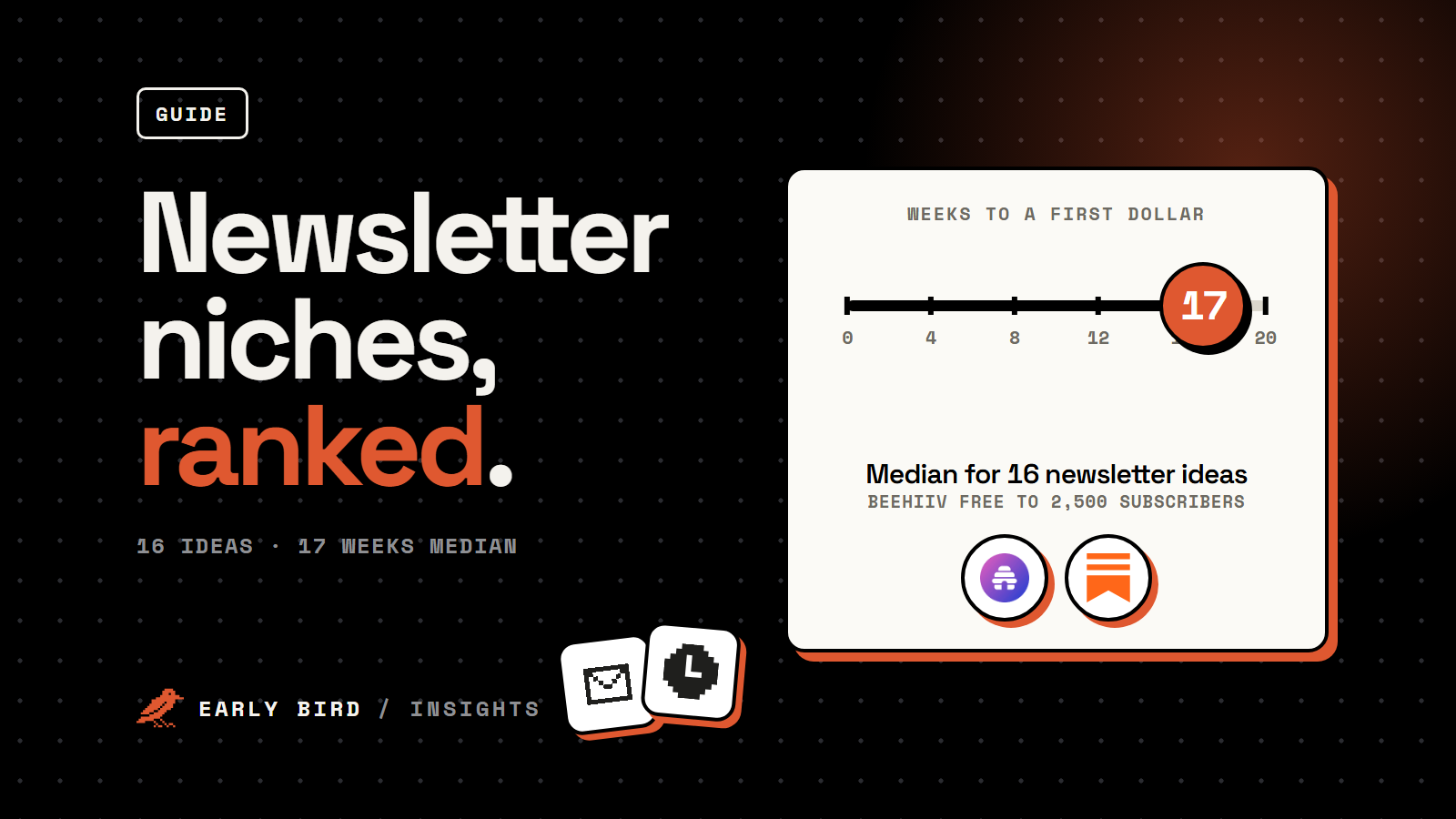
A niche newsletter is cheap to start and slow to earn. Across the 16 newsletter ideas we researched, the median is about four months to a first dollar, 14 of 16 estimate four months or more, and the median potential is $1,500 a month. 15 of 16 need ten hours a week or less, and beehiiv is free up to 2,500 subscribers.
Key takeaways
- The median newsletter idea on our board takes 17 weeks, about four months, to a first dollar, and 14 of 16 estimate four months or more.
- The median potential is $1,500 a month, and every one of the 16 ideas is built as an asset rather than a replacement income.
- 15 of the 16 need ten hours a week or less, and every one needs writing as a skill.
- beehiiv's free plan covers up to 2,500 subscribers, and it says it takes 0% of paid subscription revenue. Substack takes 10%.
- A flat $59 beehiiv plan beats Substack's 10% once paid revenue passes about $590 a month, if you need that plan.
Newsletters are the quiet end of online business. You write, people read, and eventually someone pays. The hard part is the word eventually, and the choice of niche decides how long it lasts.
We researched 16 newsletter ideas as part of 370 online business ideas, and every board figure below comes from them. The revenue figures are estimates of potential, not earnings, and the method is in how we research. The ten niche types further down are our own editorial list, ranked by how fast a small list can turn into money. They are not a count of board ideas.
What does our data say about newsletter businesses?
Cheap, light and slow.
| Newsletter ideas | Figure |
|---|---|
| Ideas researched | 16 |
| Cost nothing to start | 6 (38%) |
| Cost under $500 | 9 |
| Beginner ideas | 8 (50%) |
| Ten hours a week or less | 15 (94%) |
| Median weeks to first dollar | 17 (about 4 months) |
| Estimate four months or more | 14 of 16 |
| Estimate six months or more | 3 of 16 |
| Median potential a month | $1,500 |
All 16 need writing as a skill, and none needs coding. Their goal is an asset, not an income: every idea lists building an asset, and none lists replacing an income. beehiiv is in 15 of the 16, Stripe in 5 and LinkedIn in 5. The ideas span 12 industries, so the niche is a choice, not a given.
How do newsletters earn?
Three ways, and they work at very different list sizes.
Leads for your own service. The newsletter brings in customers for something you sell, such as a local agency or a consultancy. A few hundred readers in the right niche can be enough, because one customer pays you directly.
Sponsors. A business pays to reach your readers. beehiiv's pricing page lists an Ad Network on its paid plans but not its free plan, and on its Lite plan not during trials or in all regions. It needs an audience large enough to interest a sponsor.
Paid subscriptions. Readers pay monthly. This needs trust and a clear reason to pay.
What do the platforms cost?
At the time of writing (October 2026):
| beehiiv | Substack | |
|---|---|---|
| Free plan | Up to 2,500 subscribers | Not stated on the page we fetched |
| Paid plans, for up to 1,000 subscribers | Lite $59 a month ($49 on annual billing), Pro $109 ($95) | Not stated on the page we fetched |
| Cut of paid subscriptions | 0%, Stripe fees still apply | 10%, minus credit card fees |
Here is the sum, as an illustration. Say you charge $8 a month and have 100 paying readers, which is $800 a month. Substack's 10% is $80. On beehiiv, the 0% means no cut, but if you need Lite it is $59 a month. A flat $59 beats a 10% cut once paid revenue passes about $590 a month, or $490 on annual billing at $49. Below that, Substack is cheaper. Both pass card fees on top, and we have not checked which beehiiv plan paid subscriptions need, so check that before you choose.
How many readers do you need?
Another illustration, with an assumed conversion rate that is ours, not a measured one. Suppose 5% of readers pay $8 a month. A list of 1,000 readers then has 50 payers and earns $400 a month, of which Substack's 10% would take $40. A list of 2,500, the top of beehiiv's free plan, earns $1,000.
Those numbers are why a paid-only newsletter is the slowest route on the board. Reaching 1,000 engaged readers is the hard part, and it is why 14 of our 16 ideas estimate four months or more. A newsletter that sells your own service needs far fewer readers, because the readers are leads and one of them is worth a whole month of subscriptions.
A sensible first run is twelve issues, one a week, before you judge. Three months is enough to see whether people open, reply and forward, which tells you more than the subscriber count does.
The 10 newsletter niches, ranked by how they earn
Ranked by how directly a small list becomes money. It is our judgement, not board data.
1. A local market for a high-value service
Property, home building, finance-adjacent trades in one town. Earns through leads: one reader who becomes a client pays. The catch: it is local, so the audience is small by design.
2. A trade's owners and operators
Tips for dental practices, salons or plumbers, sent to owners. Earns through leads for your own service, then sponsors from suppliers. The catch: you need to know the trade.
3. A professional digest
A weekly roundup of news that people in one job need. Earns through sponsors, since business readers are valuable to advertisers. The catch: it must be consistently useful.
4. Job and freelance listings
A curated list of roles in a niche. Earns through paid listings from employers. The catch: you need relationships on both sides.
5. Tools and software picks
A newsletter reviewing tools for one group. Earns through sponsors and affiliate links. The catch: disclosure rules apply, see is affiliate marketing worth it.
6. Local events and openings
What is on in a town this week. Earns through local business sponsors. The catch: needs a town big enough to have sponsors.
7. Hobby and enthusiast niches
Fishing, climbing, gardening. Earns through sponsors and affiliate links from specialist brands. The catch: fans are loyal but the lists grow slowly.
8. Deals and discounts
A digest of the best offers in a category. Earns through affiliate commissions. The catch: the money is thin per click.
9. Career advice for one role
Weekly advice for, say, new managers. Earns through a paid tier or a course. The catch: free career advice is everywhere, so yours needs specifics.
10. A paid resource club
Templates and guides for a niche, behind a paid tier from the start. Earns through subscriptions. The catch: the slowest, because people pay only after they trust you.
How to choose, and what to do next
- Choose a niche where one reader is worth real money. That makes a small list enough.
- Start on a free plan. beehiiv's free tier covers 2,500 subscribers, which is more than most newsletters reach in the first months.
- Plan for four months. Publish 12 issues before judging, and send each one to people you know are in the niche.
- Pair it with something to sell. A service or product turns a small list into income sooner than ads do.
If you would rather get paid faster, services are quicker, and our timeline data puts numbers on it. For other free starts, see online business ideas with no money, and for the lead generation route see how to start a lead generation business. Or take the 60 second quiz to match ideas to your hours.
Questions people ask
What is the best niche for a newsletter?
The best niche is one where a single reader is worth a lot to someone, such as a local property market or a trade with expensive customers. That lets a small list pay through leads or sponsors. Broad niches need huge lists. Our ranking below goes from fastest to slowest earning.
How do newsletters make money?
Three main ways: sponsors paying to reach your readers, readers paying for a paid tier, and the newsletter bringing in customers for your own service. Lead generation for your own service is usually the quickest on a small list. Sponsors and paid tiers need a larger audience.
How long does a newsletter take to make money?
In our research of 16 newsletter ideas the median is 17 weeks, about four months. 14 of the 16 estimate four months or more and 3 estimate six months or more. Only 1 estimates a first dollar within four weeks.
Is beehiiv or Substack better for a new newsletter?
At the time of writing (October 2026), beehiiv is free up to 2,500 subscribers and says it takes 0% of paid subscription revenue, with Stripe fees on top. Substack takes 10% of paid subscription revenue plus card fees. For a free newsletter either works, and the choice matters once you charge.
Can you start a newsletter with no money?
Yes. 6 of the 16 newsletter ideas we researched cost nothing to start, and 9 more cost under $500. A free beehiiv plan covers up to 2,500 subscribers. What you spend is time, 5 to 10 hours a week for most of them.