Opinion
Is faceless YouTube worth it in 2026? What the rules and our data say
The short answer
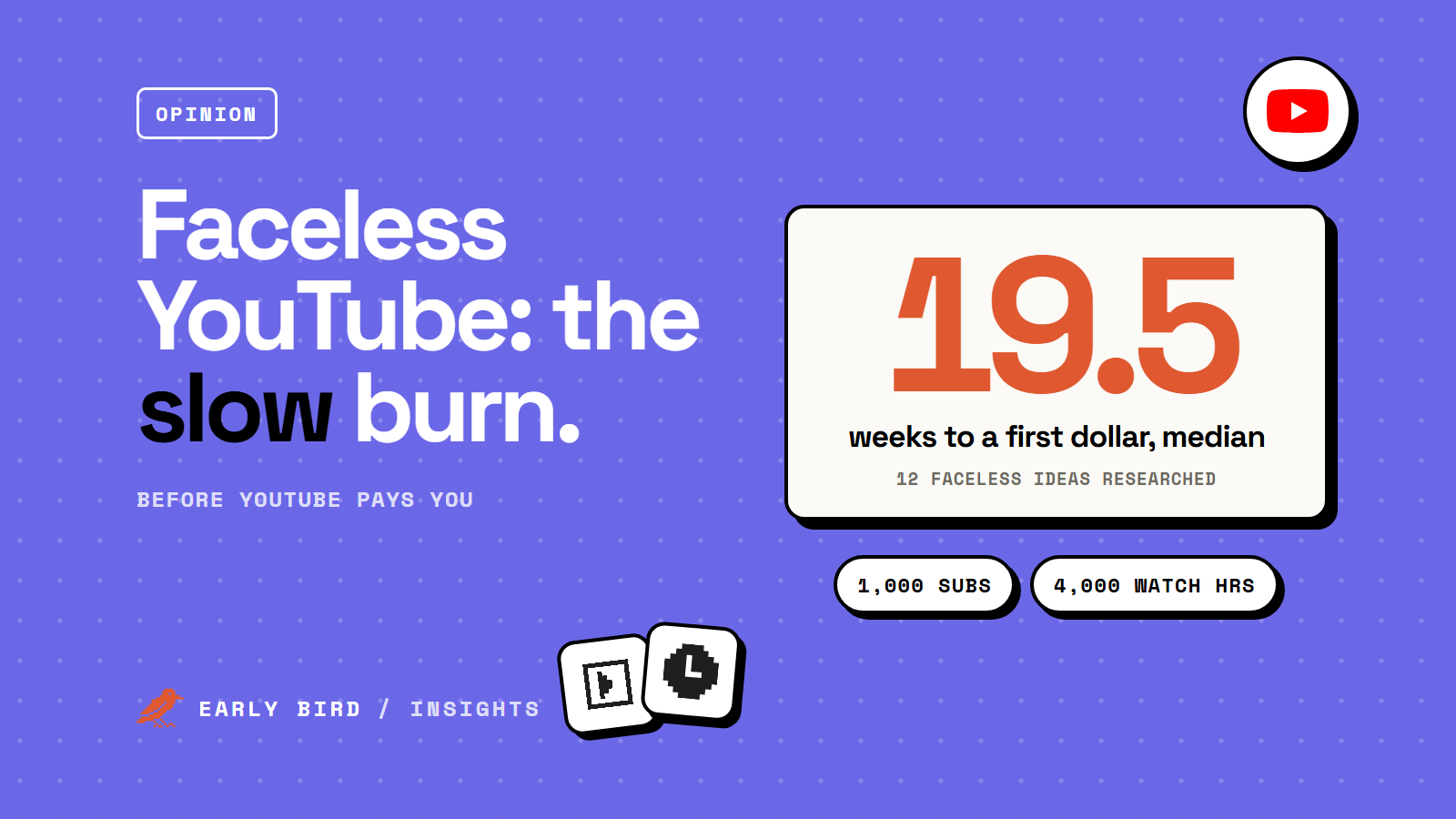
A faceless YouTube channel can be worth it, but only as a slow build. In our research the median faceless idea takes about four and a half months to a first dollar, and 5 of 12 estimate six months or more. YouTube pays only after 1,000 subscribers and 4,000 watch hours, and its rules exclude templated, mass-produced or generic AI videos.
Key takeaways
- The median faceless content idea in our research takes 19.5 weeks, about four and a half months, to a first dollar.
- 5 of the 12 faceless ideas estimate six months or more, and only 4 estimate three months or less.
- YouTube Partner Program needs 1,000 subscribers plus 4,000 watch hours in 12 months, or 10 million Shorts views in 90 days.
- YouTube's inauthentic content policy excludes videos that look made from a template, and generic AI content made without original insight.
- The median potential is $2,250 a month, and none of the 12 ideas lists replacing an income as a goal. They are built as assets.
Faceless YouTube is sold as the easy version of content: no camera, no personality, an AI voice over stock footage. It is cheap to start, and that is true. Whether it is worth your year is a different question, and the answer depends on rules most videos about it skip.
We researched 12 faceless content ideas as part of 370 online business ideas, and every board figure below comes from them. The revenue numbers are estimates of potential, not earnings, and you can read how we make them in how we research. The YouTube rules are quoted from YouTube's own help pages.
What does YouTube require before it pays a channel?
At the time of writing (October 2026), the Partner Program needs 1,000 subscribers, plus one of two things:
- 4,000 qualified watch hours in the last 12 months (watch hours from Shorts in the Shorts feed do not count towards this), or
- 10 million qualified Shorts views in the last 90 days.
That is a high bar for a new channel with no audience, and it is the reason a faceless channel takes months. Until you reach it, ad revenue is zero, however many videos you post.
Does YouTube allow faceless channels?
Yes. Nothing in the policy depends on whether a face appears. What it targets is what YouTube calls inauthentic content, the new name since 15 July 2025 for what used to be repetitious content. YouTube's help page says generic or repetitive content "includes content that looks like it's made with a template", and it lists AI-generated content made with generic or unoriginal templates as not allowed. It also excludes videos that stitch together unrelated AI clips to surprise or shock viewers.
It allows AI that supports your own work, such as helping to edit scripts or visualising a character and story you invented, provided the result shows your creative vision. AI personas presenting as experts on health, legal, financial or political advice are not monetisable.
The practical reading is simple. A channel that mass-produces near-identical videos from a template is the exact thing the policy was written for, and a channel with its own angle, research and script in every video is not.
What kind of faceless channel survives the rules?
YouTube's help page gives the test in its examples. The allowed side is content that shows your own insight or creative vision, and the excluded side is generic, templated or mass-produced material. That points to a rough sorting:
- Likely fine: a channel that explains a subject you have researched, with your own script, your own screen recordings or your own charts, and an AI voice reading words you wrote.
- Likely fine: a tutorial channel built on screen recordings of work you actually did.
- Likely at risk: many near-identical videos assembled from stock clips and a generic script, uploaded on a schedule.
- At risk and off limits: an AI persona giving health, legal, financial or political advice, which YouTube says is not monetisable.
This is our reading of a policy YouTube can change, not a ruling. Read the live page before you build a content plan around it.
How long does a faceless channel take to earn?
Longer than almost anything else on our board.
| Faceless content ideas | Figure |
|---|---|
| Ideas researched | 12 |
| Median time to a first dollar | 19.5 weeks (about 4.5 months) |
| Estimate six months or more | 5 of 12 |
| Estimate three months or less | 4 of 12 |
| Median potential a month | $2,250 |
| Beginner ideas | 6 of 12 |
| Hours a week | 7 need 5 to 10, 5 need 10 to 20 |
The spread is wide. The fastest estimates are three and six weeks, and the slowest are eight months. None of the 12 needs under five hours a week, and none lists replacing an income as a goal. 10 of the 12 list building an asset. That matches how these channels behave: they are something you build while you do something else.
What does the watch-hours maths look like?
This is an illustration, not a forecast. 4,000 hours is 240,000 minutes. If the average viewer watches 4 minutes, that is 60,000 views. Post two videos a week for a year, 104 in all, and each needs roughly 577 views on average, before you count the 1,000 subscribers. If viewers watch only 3 minutes, you need 80,000 views, and at 5 minutes, 48,000.
The Shorts route is harsher. 10 million views in 90 days is about 111,000 a day. Most new channels never see that, which is why we treat the 4,000 hours path as the realistic one.
What does it cost to start?
Very little in money. 9 of the 12 ideas cost under $500 and 3 cost nothing. Claude appears in most of our plans because our plans are written around Claude prompts, so we leave it out of the tool count. CapCut, for editing, is in 10 of the 12 ideas, and ElevenLabs, for the voice, is in 8. ElevenLabs' pricing page lists a commercial licence from its Starter plan up, and does not list one on the free plan, so check the licence before you publish anything for money.
The real cost is time: five to twenty hours a week for months with no income.
So is faceless YouTube worth it?
Worth it, under three conditions:
- You can wait. Plan for six months of work before the first payment, and possibly twelve.
- Every video has something original. A real angle, your research, your script. That is what the policy rewards, and it is what viewers keep watching.
- You have a second route to income. Sponsors, affiliate links or your own product do not need the Partner Program. A channel that only sells ads is the slowest version.
If you need money in the next three months, pick a service. Our timeline data shows services reach a first dollar in around four weeks. If you want the voice work without the channel, the AI voiceover side hustle is a faster route to the same tools.
What does a sensible first six months look like?
An illustration, built from the sums above. Two videos a week for 26 weeks is 52 videos. To reach 4,000 watch hours from them alone, each would need about 4,600 minutes of total watch time, roughly 77 hours, which at 4 minutes a view is about 1,150 views each. Few new channels get that in six months, which is why the median idea on our board estimates a first dollar after about four and a half months, and why 5 of 12 say six months or more.
So the plan is not to hit the threshold in half a year. It is to learn quickly:
- Weeks 1 to 8: publish steadily and watch which videos hold viewers past the first minute.
- Weeks 9 to 20: make more of what held viewers, and drop what did not.
- Month 6: judge the channel on retention and subscriber growth, not on income.
What to do next
Before you start a channel, post five videos and see what happens, rather than buying a course. If you can keep that pace for two months and add real value each time, carry on. If you want to compare it with faster ideas first, see what 370 ideas cost and take, or take the 60 second quiz to see which ideas match your hours.
Questions people ask
Is a faceless YouTube channel worth starting in 2026?
It is worth it if you can treat it as a year-long build and add something original to every video. In our research the median faceless idea takes about four and a half months to a first dollar. It is a poor choice if you need money within three months.
Does YouTube allow faceless channels?
Yes, the rules are about originality rather than showing a face. YouTube's inauthentic content policy excludes content that looks made from a template, repetitive uploads, and AI content made with generic or unoriginal templates. Using AI to help edit scripts is allowed if the result shows your own creative vision.
How many subscribers and views do you need to earn on YouTube?
At the time of writing (October 2026), YouTube's Partner Program requires 1,000 subscribers plus either 4,000 qualified watch hours in the last 12 months or 10 million qualified Shorts views in the last 90 days. Watch hours from Shorts in the Shorts feed do not count towards the 4,000.
Can AI-generated YouTube videos be monetised?
Some can, but generic ones cannot. YouTube says AI content made with generic or unoriginal templates is not allowed, and neither are videos that stitch together unrelated AI clips to shock viewers. AI personas presenting as experts on health, legal, financial or political advice are not monetisable either.
How much does it cost to start a faceless channel?
Most faceless ideas in our data are cheap: 9 of 12 cost under $500 and 3 cost nothing. The common tools are CapCut for editing, in 10 of 12 ideas, and ElevenLabs for voice, in 8 of 12. The cost that matters is your weekly time, 5 to 20 hours.