Data
What 370 researched online business ideas cost, need and take to make a first dollar
The short answer
Across 370 online business ideas we researched by hand, 93% cost under $500 to start, 87% need no coding and 59% fit into ten hours a week or less. The typical idea takes four to five weeks to a first dollar, and one in five takes over two months. Content businesses are the slowest by far.
Key takeaways
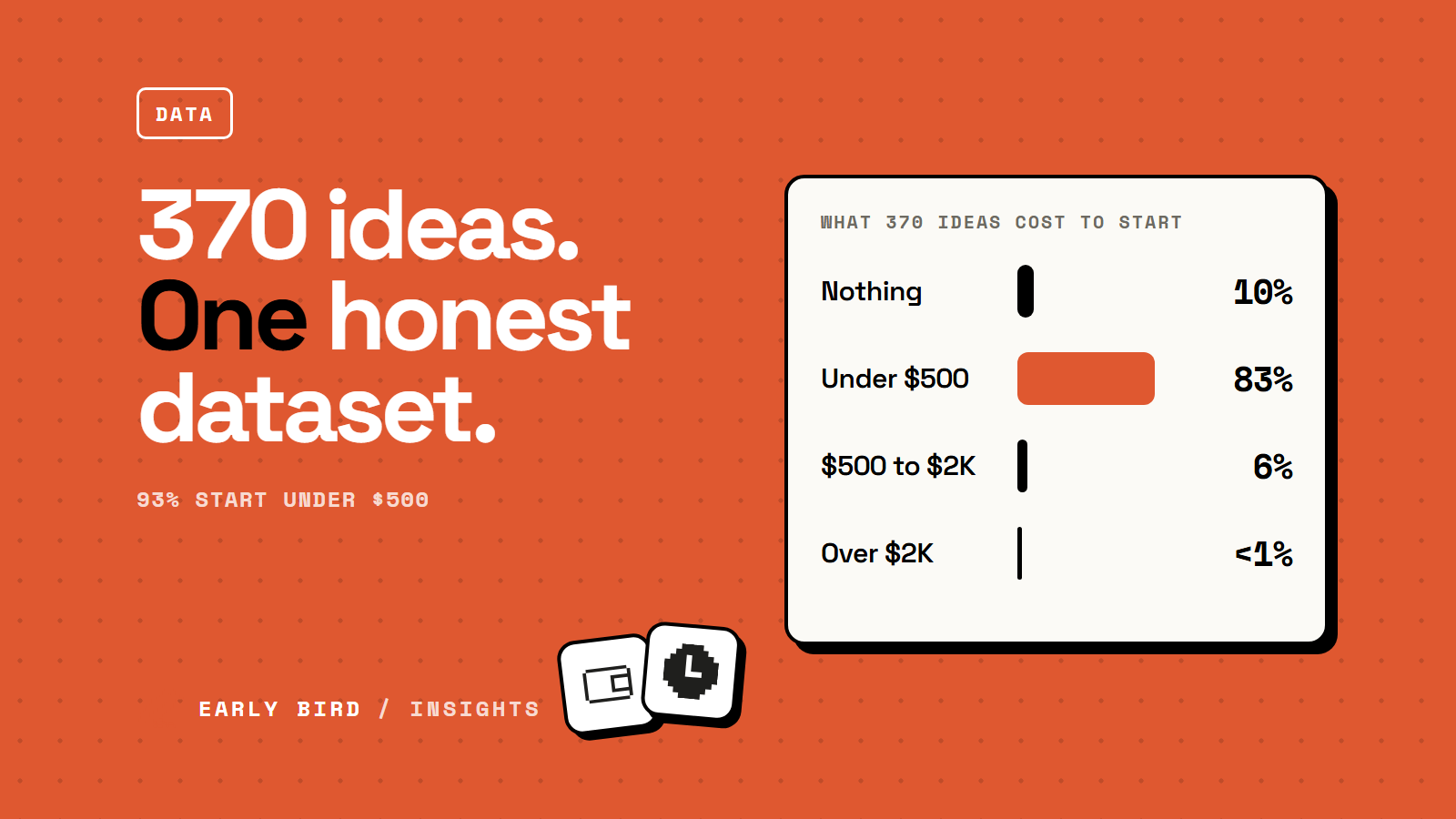
- 93% of the 370 ideas cost under $500 to start, and 10% need no money at all.
- 87% need no coding, and the most common skill asked for is selling, not building.
- Half reach a first dollar within four weeks; one in five take longer than two months.
- Service businesses are the fastest to a first payment. Content businesses, like faceless channels and newsletters, are the slowest, at around four months.
- Beginner ideas start cheaper and faster, but their potential is lower: a median of $1,500 a month against $4,750 for advanced ones.
Most lists of online business ideas give you fifty names and a sentence each. This is the opposite: one dataset, 370 ideas we researched by hand between August and October 2026, and what they actually ask of you. The cost to start, the hours, the skills, the tools and how long the first payment usually takes.
Every idea pairs one business model with one industry, and every figure below comes from that research. You can read exactly how we did it in how we research. The revenue figures are our estimates of potential, not anyone's results.
How much does it cost to start?
Very little, for most of them. 345 of the 370 ideas (93%) cost under $500 to start, and 38 (10%) need no money at all.
The money that is spent goes on software subscriptions, and many of the tools have free plans to start on. Claude has a free plan, with Pro at $20 a month. Canva is free, with Pro at US$144 a year. The ideas that need more than $500 are mostly lead generation, where you pay for ads before you have a client to bill.
How much time does it take each week?
Most ideas fit around a job. 219 ideas (59%) need ten hours a week or less.
| Hours a week | Ideas | Share | Median potential a month |
|---|---|---|---|
| Under 5 | 37 | 10% | $1,500 |
| 5 to 10 | 182 | 49% | $2,000 |
| 10 to 20 | 141 | 38% | $3,000 |
| Over 20 | 10 | 3% | $4,500 |
The pattern is the one you would expect, and it is worth saying plainly: the more hours an idea needs, the higher its potential. There is no idea on the board that pays well for very little time.
How hard are they?
A third are beginner ideas. Most sit in the middle.
| Difficulty | Ideas | Share | Median potential a month | Median weeks to first dollar |
|---|---|---|---|---|
| Beginner | 121 | 33% | $1,500 | 4 |
| Intermediate | 221 | 60% | $2,500 | 4 |
| Advanced | 28 | 8% | $4,750 | 6 |
Advanced ideas have three times the potential of beginner ones, and take a little longer to pay. If you are starting from nothing, a beginner idea is still the better first move: it is cheaper, and the first dollar teaches you more than the bigger number promises.
What skills do they need?
Selling, more than building. 87% of the ideas need no coding at all. The skill asked for most is sales, in 31% of ideas, because so many of them are services sold to other businesses.
If you can write a clear message and send it to fifty businesses, you have the main skill most of these ideas want.
Which tools come up most?
A note first, to be straight with you. Every plan on our board is built around ready-to-use prompts for Claude, so Claude appears in almost every idea. That says more about how we write plans than about the market, so we have left Claude and Claude Code out of this list.
The typical idea uses four tools. Canva shows up because so many ideas need simple visuals. Stripe is how you get paid. Twilio and Zapier are the plumbing behind the AI receptionist and automation ideas.
How long until the first dollar?
This is the number that matters most when you are choosing, and it varies more than anything else. Across all 370 ideas the median is four to five weeks. Half reach a first dollar within four weeks. One in five takes longer than two months.
The type of business explains most of the difference:
| Type of business | Ideas | Median weeks to first dollar |
|---|---|---|
| Service | 225 | 4 |
| Ecommerce | 55 | 6 |
| Software (SaaS) | 36 | 8 |
| Content | 28 | 17 |
| Newsletter | 16 | 17 |
Services are fastest because you can sell before you build: one conversation with a business owner can become an invoice. Content and newsletters are slowest because they earn through an audience, and an audience takes months. YouTube, for example, only pays creators once a channel has 1,000 subscribers and 4,000 watch hours in a year, or 10 million Shorts views in 90 days. We break this down by every business model in how long it takes to make money online.
What could they make?
The median potential across all 370 ideas is $2,500 a month. We show the median, not the top, because the top of any list is where the misleading numbers live.
These are estimates of what an idea could make once it is running, worked out as a number of customers at one price. They are not what anyone has earned, and they leave out your time, your costs and tax. Most new businesses take longer to get there than their founder hopes. Read them as the size of the opportunity, not a forecast.
What this means if you are choosing one
Three things stand out from the data:
- Cost is rarely the obstacle. Nearly every idea starts under $500. Time and selling are the real costs.
- Choose by your timeline, not the potential. If you need a first dollar this month, a service idea is far more likely to get you there than a content idea, whatever their ceilings.
- Beginner ideas are a real starting point, not a consolation prize. They are cheaper, quicker to a first payment, and the skills carry over to the bigger ideas.
If you want ideas filtered to your own budget and hours, start with online business ideas under $500, or take the 60 second quiz and the board will sort itself to fit you.
About this data
The figures cover the 370 ideas live on the Early Bird board on 14 October 2026, researched between 20 August and 13 October 2026. It is a curated sample, not a census of every online business: it leans towards ideas we could find evidence for, so newer niches are under-represented. A small number of ideas are built on custom GPTs, which OpenAI has announced it is retiring in favour of plugins, and we are reviewing those. You are welcome to cite these figures with a link to this page.
Questions people ask
How much does it cost to start an online business?
Most of the ideas we researched cost very little. 93% need under $500, mostly for a few software subscriptions, and 10% can start with nothing, using free plans. The 7% that need more are usually ones that run paid ads from day one.
How long does it take an online business to make money?
The typical idea in our research takes four to five weeks to a first dollar. Services sold to businesses are the quickest, often three to four weeks with daily outreach. Content businesses take months, because an audience has to build before it can earn.
Do you need to code to start an online business?
Not for most. 87% of the ideas we researched need no coding at all. The skills that come up most are selling, no-code tools, writing and marketing. Coding matters mainly for software ideas such as micro SaaS and apps.
What is the easiest online business to start?
By our data, print on demand and digital products are the most beginner friendly, with nearly every idea in those models marked beginner. The trade-off is a lower ceiling: beginner ideas have a median potential of $1,500 a month.
Are these revenue figures real earnings?
No. They are our estimates of what each idea could make once running, worked out as a number of customers at one price. They are not results and not a promise, which is why we show medians and label them as potential.