Guides
How to start a lead generation business, what it costs and the spam rules to follow
The short answer
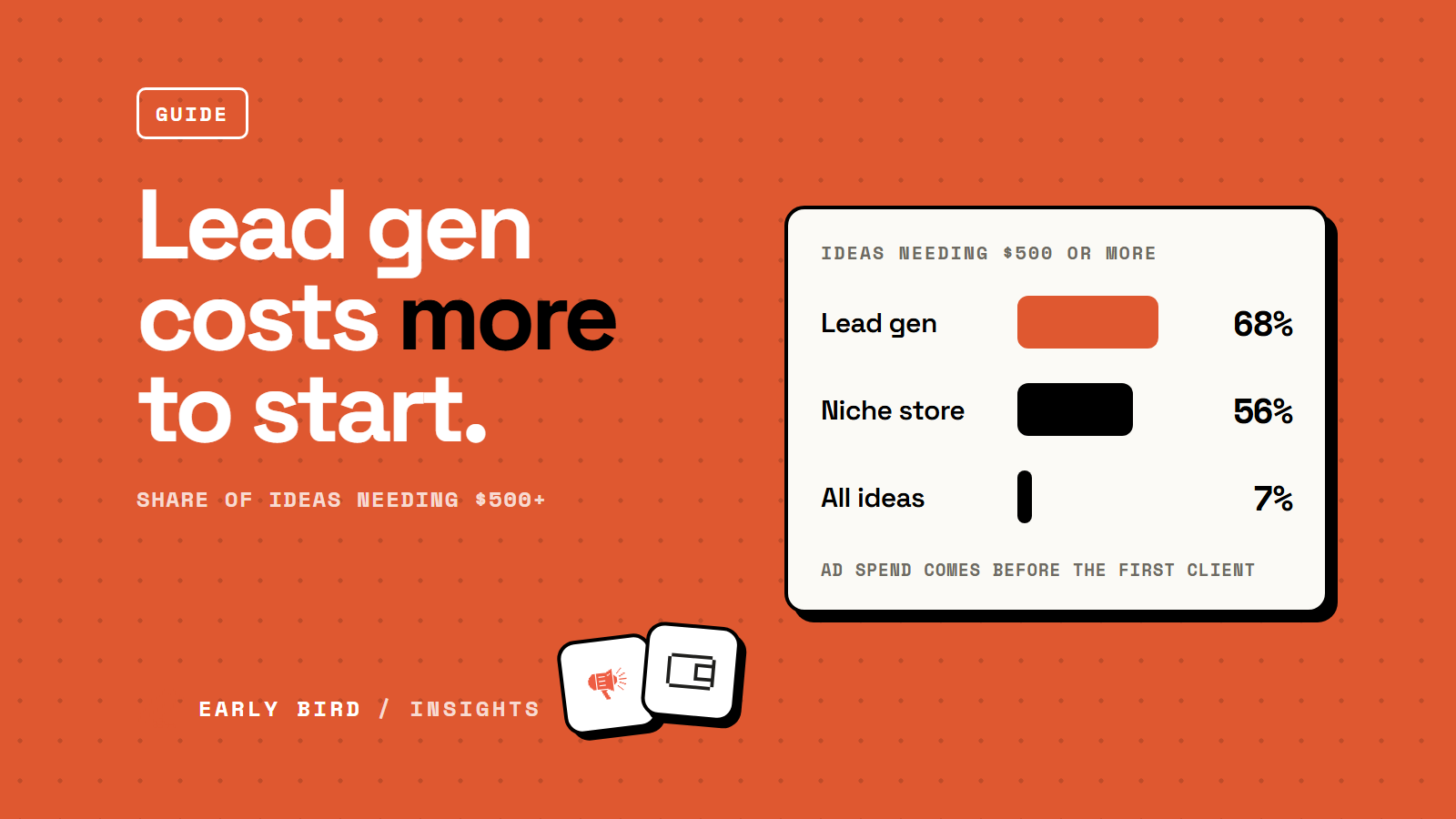
Lead generation means finding enquiries for local businesses with paid ads and forms, then charging per lead or a monthly retainer. Of the 25 lead generation ideas we researched, 68% need $500 to $2,000 to start, against 7% of all 370 ideas, because you pay for ads before you invoice. The median first dollar takes six weeks, and none are beginner ideas.
Key takeaways
- 17 of the 25 lead generation ideas (68%) need $500 to $2,000 to start, and they make up 17 of the 23 ideas in that cost band across the whole board.
- The median wait for a first dollar is six weeks, and the median potential is $4,500 a month, the joint highest of 17 models, which is an estimate and not earnings.
- None of the 25 are beginner ideas, 88% need 10 to 20 hours a week, and 96% list marketing as a skill.
- Meta Ads, Google Ads and GoHighLevel each appear in 64% of the ideas, and GoHighLevel's Starter plan is $97 a month at the time of writing.
- Both US and Australian spam law need you to identify yourself and honour opt-outs, and Australia requires consent before you send, so buying a list is risky.
Lead generation looks simple on paper. A local business wants more enquiries, you run ads that produce them, and you charge for each one. What the videos leave out is that you spend the money first, that the clients are demanding, and that the rules on contacting people are real. This guide sets out the costs and the rules.
The figures come from the 25 lead generation ideas among the 370 researched for the Early Bird board, and the method is in how we research. Revenue figures are estimates of potential, not earnings. Prices and rules were read from the official pages on 15 October 2026, and none of this is legal advice.
What is a lead generation business?
You generate leads, meaning people who have asked a business for a quote or a call, and you sell them to that business. The usual shape is a landing page, a paid ad on Meta or Google, a form, and a way to send each enquiry to the client quickly. The product is booked conversations, not clicks.
It is a service, and the data says it behaves like a demanding one. In our research lead generation has a median potential of $4,500 a month, the joint highest of the 17 models we track, but no idea in the group is rated beginner: 17 are intermediate and 8 are advanced. Nearly every one lists marketing (96%) and sales (92%) as skills. A median of six weeks to a first dollar sits between fast services and slow software.
Why does it cost more to start than other ideas?
Because the advertising is yours to pay for until a client pays you. Across all 370 ideas, 93% cost under $500 to start. For lead generation the picture reverses:
| Starting cost | Lead generation ideas | Share of 25 |
|---|---|---|
| Nothing | 1 | 4% |
| Under $500 | 7 | 28% |
| $500 to $2,000 | 17 | 68% |
| Over $2,000 | 0 | 0% |
Lead generation accounts for 17 of the 23 ideas on the whole board that need $500 to $2,000, so it is the main reason that band exists. It is also the most time hungry: 22 of the 25 need 10 to 20 hours a week, against 38% of all ideas.
The tools show where the money goes. Meta Ads, Google Ads and GoHighLevel each appear in 16 of the 25 ideas (64%). GoHighLevel is a customer management and automation platform. At the time of writing (October 2026) its Starter plan is $97 a month for three sub-accounts, Unlimited is $297 and Agency Pro is $497, and each plan offers a 14 day free trial. Ad spend is on top. A practical test budget is the lead cost you can afford to lose while you find one working ad, which is why the starting band is higher.
Pay per lead or monthly retainer?
Both work, and they fail in different ways. This table is our reasoning, not board data.
| Pay per lead | Monthly retainer | |
|---|---|---|
| Who funds the ads at first | You | Usually the client, as a separate budget |
| How you are paid | Per qualified lead, often after delivery | Monthly, in advance if you ask |
| Main risk | Spending more on ads than the leads sell for | Client expects results, then cancels |
| Best when | You have one working ad and a proven client | You can deliver steady results |
The sums for pay per lead are simple, and worth doing before you start. Take assumed numbers, not benchmarks: if a lead costs you $15 in ads and you sell it for $40, you keep $25 per lead before your tools and time. If the ad produces a lead at $45, you lose $5 on each one you deliver. The whole game is the gap between your cost per lead and the price, which you only learn by spending.
A sensible path for a beginner is a small paid pilot with one client: a fixed number of leads for a fixed price, with the client agreeing the budget in writing. Move to a retainer once the same ad keeps working. For how to find that first client, see how to get your first client.
What do the ad platforms require?
Read the platform rules before you build a funnel around them. Google's lead form policy page says you must provide a link to your privacy policy when you create a lead form, that the account must be in an eligible vertical, and that sensitive verticals are not eligible. For lead forms placed in Video or Display campaigns, or in a Search campaign whose headline opens straight to the form, it sets spend thresholds: more than $50,000 USD in total Google Ads spend, or more than $1,000 USD per account with extra verification. A new account may therefore not be able to use every lead form format at first.
We could not verify Meta's official minimum budget or lead ad rules from its own pages, so we are not quoting any. Check the budget field in Ads Manager and Meta's current policies yourself before you commit money.
What are the consent and spam rules?
If you email or text people, you are covered by spam law, and hiring someone else to send does not remove your duty. Two official sources, neither of which is legal advice:
United States (FTC, CAN-SPAM). The law makes no exception for business to business email. Your header and subject line must be accurate, the message must be identified as an ad, it must include a valid postal address and a clear way to opt out, and you must honour an opt-out within 10 business days. Penalties can reach $53,088 per email that breaks the rules. The FTC guide describes opt-out rights rather than prior consent, which is the opposite approach to Australia's.
Australia (ACMA, Spam Act). You must have consent from the recipient before sending marketing messages or emails, even if someone else sends them for you. Express consent, such as a ticked box on a form, is best practice, and it is up to you to prove it. Every message must identify you and include an unsubscribe option that is honoured within five working days. ACMA also says you must take care with bought lists, because you remain responsible for consent, and you cannot use lists made with address harvesting software.
How to start, step by step
- Choose one local niche where a single new customer is worth a lot, such as roofing or dental work, and one clear offer.
- Build one landing page with a short form and a privacy policy link.
- Run a small test on one ad until you know your real cost per lead. Stop if you cannot beat the price you could charge.
- Sign one client on a pilot in writing, with the lead definition, price and ad budget agreed.
- Follow up every lead within minutes and track which become customers, so you can show the client results.
- Keep records of consent from day one.
If you want something cheaper and faster to begin with, compare an AI receptionist service, where all 19 of our ideas cost under $500 to start. For the wider cost picture, see how much it costs to start an online business, or take the 60 second quiz to match ideas to your budget.
About this data
Figures cover the 25 lead generation ideas live on 14 October 2026, out of 370. Vendor prices and legal summaries were read from official pages on 15 October 2026, and rules change, so check them before you rely on them.
Questions people ask
How do you start a lead generation business?
Pick one kind of local business, such as roofers or dentists, and one offer, such as booked quotes. Build a landing page and a paid ad for it, deliver a small batch of leads to one client, and charge per lead or monthly. Expect to pay for ads before you are paid.
How much does it cost to start a lead generation agency?
In our research 68% of lead generation ideas need $500 to $2,000, mostly for ad spend and a customer management tool. GoHighLevel's Starter plan is $97 a month at the time of writing. That compares with 93% of all 370 ideas costing under $500.
Is pay per lead or a retainer better?
Pay per lead aligns your income with results but you carry the ad risk and wait to be paid. A retainer pays on a schedule and the client usually funds the ads, but they expect results. Beginners often start with a small paid pilot, then move to a retainer once leads are consistent.
Is lead generation legal?
Yes, but the rules on contacting people are strict. US law, through CAN-SPAM, requires accurate sender details, a postal address, an ad label and opt-outs honoured within 10 business days. Australia requires consent first and unsubscribes honoured within 5 working days. This is general information, not legal advice.
Do you need a website to start lead generation?
You need a landing page for each offer, and ad platforms often need a privacy policy link on the form. Google, for example, requires a link to your privacy policy when you create a lead form. A simple one page site on a low cost builder is enough to begin.