Guides
How to start an AI receptionist business: steps, tools, costs and the legal basics
The short answer
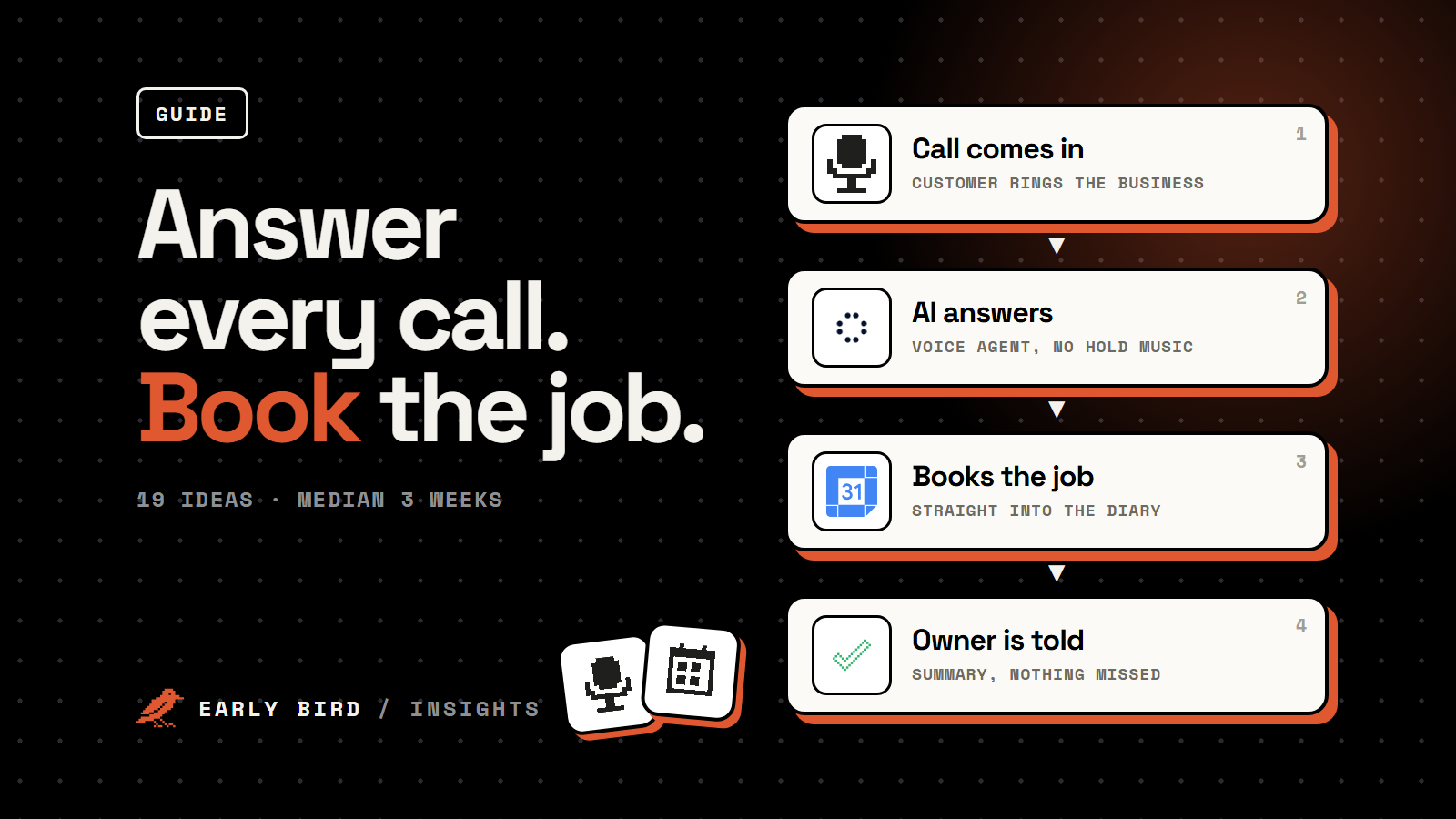
To start an AI receptionist business, pick one trade, build a working voice agent on a platform such as Retell or Vapi, check call recording and AI disclosure rules for the client's state, and demo it to local business owners. The 19 ideas we researched all start under $500, with a median of 3 weeks to a first dollar.
Key takeaways
- All 19 AI receptionist ideas on our board can start for under $500, and the median is 3 weeks to a first dollar, with a range of 2 to 6.
- Retell AI appears in 13 of the 19 ideas, Google Calendar in 12 and Twilio in 11.
- Platform costs are low: Vapi lists $0.05 a minute for hosting, and Retell lists voice agents from $0.07 a minute, at the time of writing (October 2026).
- About 11 US states require every party to consent to a recording, according to the Reporters Committee for Freedom of the Press, so recording needs a clear disclosure.
- 74% of these ideas list selling as a required skill, and only 16% are beginner level, so the hard part is the conversation with the owner, not the technology.
An AI receptionist answers a business's phone, takes a message or books an appointment, and does it at 2am as readily as at 2pm. The pitch to a plumber or a dentist is simple: you lose a job every time the phone rings out. What is less simple is turning that into a business, which means building something that works, staying on the right side of recording rules and persuading a busy owner to trust it.
The figures here come from the 19 AI receptionist ideas among the 370 researched ideas on our board, explained in how we research. Prices come from each company's own page, read in October 2026. Potential revenue is our estimate, never anyone's earnings. Nothing in the legal section is legal advice.
What do the board figures say about this business?
It is fast, cheap to start and not easy to sell. The 19 ideas:
| Measure | AI receptionist ideas |
|---|---|
| Ideas on the board | 19 |
| Can start for under $500 | 19 (100%) |
| Median weeks to a first dollar | 3 (range 2 to 6) |
| Median potential a month | $4,500 |
| Beginner level | 3 (16%) |
| Need 5 to 10 hours a week | 12 (63%) |
| List selling as a skill | 14 (74%) |
| List no-code as a skill | 16 (84%) |
The potential figure is a number of clients at one price. It is the size of the opportunity, not a first month. The three week median assumes you are speaking to business owners most days. The tools that recur are Retell AI (13 ideas), Google Calendar (12) and Twilio (11). Every plan on our board is written around Claude prompts, which is why Claude is in all 19, so we have not counted it as a finding.
Which steps take you from nothing to a first client?
1. Pick one trade and one job
Choose a single industry and a single call type, such as booking a quote visit for an electrician or a first appointment for a dental practice. A narrow agent sounds better and is easier to sell. In our research the industries that come up most for this model are medical, trades and real estate, three ideas each, but spread across 11 industries, so there is no single obvious winner.
2. Build a working agent on free credit
Retell gives $10 of free credit on its pay-as-you-go plan at the time of writing, and Vapi gives $5. Build an agent that greets the caller, asks what they need, checks a calendar and books or takes a message. Write the instructions in plain English, test it on at least ten calls, and fix every place it stumbles.
3. Choose your stack
The platform is the main choice. Retell lists $0.055 a minute for voice infrastructure plus the model, the voice and telephony, from $0.07 to $0.31 a minute in total. Vapi lists $0.05 a minute for hosting, with the speech-to-text, language model and voice passed through at cost. Adding the ranges on its page, that comes to roughly $0.08 to $0.13 a minute before the phone line, our arithmetic. For the number, Twilio lists $1.15 a month for a US local number and $0.0085 a minute for inbound calls. The full cost-versus-price sums are in how much to charge for an AI receptionist.
4. Set up the legal basics before the first live call
See the next section. This takes an afternoon and is not optional.
5. Sell it by letting them call it
Do not describe it, demonstrate it. Put your demo agent on a number, tailor its greeting to the owner's business, and ask them to ring it. Then offer a short paid pilot on their real line. We cover the outreach itself in how to get your first client.
6. Price in tiers and report monthly
Charge by call volume tier and send a short monthly note showing calls answered and appointments booked. That note is what stops a client cancelling, because it is the only proof the agent earns its fee.
What are the legal and consent points?
Three things matter, and the details change by state, so treat this as a checklist for a conversation with a lawyer.
Recording. The Reporters Committee for Freedom of the Press says federal US law requires the consent of at least one party to record a call. About 11 states primarily require all parties to consent: California, Delaware, Florida, Illinois, Maryland, Massachusetts, Michigan, Montana, New Hampshire, Pennsylvania and Washington. It adds Connecticut and Nevada for phone calls specifically. For calls across state lines, it advises assuming the stricter state's law applies. The safe default is a plain spoken notice at the start of every call: this call may be recorded and is answered by an automated assistant.
AI voices. In February 2024 the US Federal Communications Commission confirmed that AI-generated voices fall under the Telephone Consumer Protection Act, which restricts calls that use an artificial or prerecorded voice without the called person's prior express consent, unless an exemption applies. That law mainly governs calls a business places, so it matters most if your agent calls people back or sends reminders. An agent that only answers inbound calls is lower risk, but ask before you build outbound features.
Sensitive information. If you serve medical or legal practices, callers may share private details. Vapi lists a HIPAA compliance add-on at $2,000 a month, which shows how much the cost changes in that corner of the market. Start with trades, salons and real estate, and add regulated industries once you have taken advice.
How long does it take to get paid?
Our median is three weeks, and the quickest ideas say two. That figure assumes you build a demo in the first week and then speak to business owners every working day. If you only message people at weekends, expect it to take longer. None of the 19 ideas in our research took beyond six weeks, but they are estimates, not results.
What should you do first?
- Choose the trade you can say five true things about.
- Spend one weekend building the agent on free credit and testing it on ten calls.
- Write the disclosure and check the recording rules for your own state and your client's.
- List 30 local businesses in that trade and let ten of them call the demo.
If you are unsure the model suits you, the 60 second quiz matches the board to your hours and skills. To see where it ranks against other AI services, read the best AI side hustles in 2026.
Questions people ask
How do I start an AI receptionist business?
Choose one type of local business, build a voice agent that answers calls and books appointments, and test it on at least ten real calls. Then demo it to owners by letting them call it. Set up call recording notices, since consent rules vary by state.
How much does it cost to start an AI receptionist business?
Very little. All 19 ideas in our research can start for under $500, and voice platforms list pay-as-you-go prices from about $0.05 to $0.31 a minute with free credits to test. The larger cost is your time spent contacting businesses.
Is it legal to record calls with an AI receptionist?
It depends on the state. Federal law requires the consent of at least one party, but about 11 states, including California, Florida and Washington, generally require all parties to consent. Tell callers at the start of the call that it is recorded, and take legal advice for your market.
Who buys an AI receptionist?
Small businesses that miss calls while the owner is working, such as trades, medical practices, salons and real estate agents. Across our 19 ideas, medical, trades and real estate are the most common industries, with three ideas each. Pick one and learn its call types.
Do I need to code?
Not usually. 84% of the AI receptionist ideas we researched list no-code tools as a skill and none list coding. You configure the agent, connect a calendar and a phone number, and write the instructions in plain English.