Guides
Online business ideas with no money: 10 ways to start free, ranked from 38 we researched
The short answer
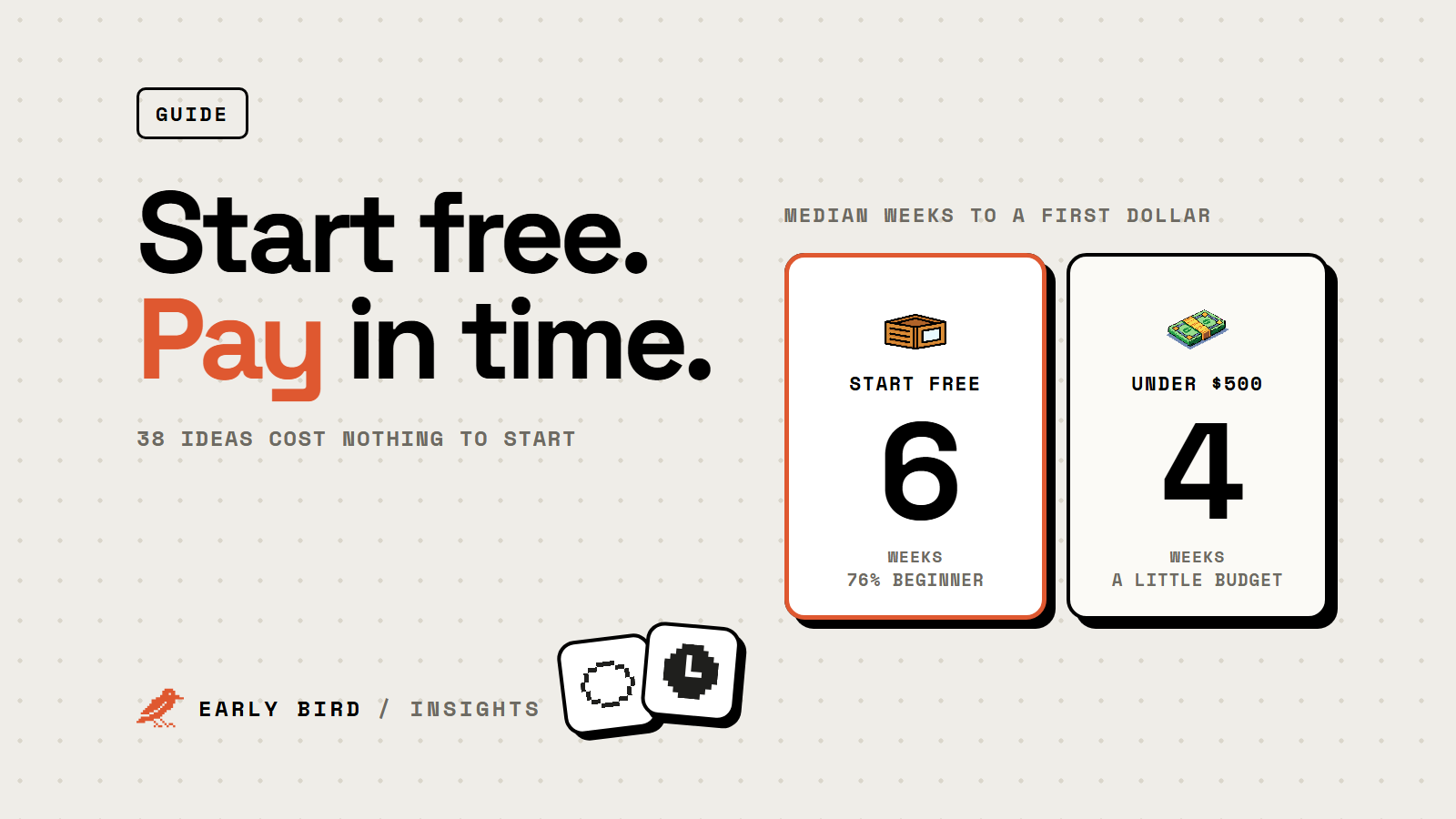
Of 370 online business ideas we researched, 38 need no money at all, run on free plans. Three quarters are beginner ideas and 89% fit into ten hours a week. The trade is time: their median is six weeks to a first dollar against four weeks for ideas with a small budget, and their median potential is $1,500 a month against $2,500.
Key takeaways
- 38 of the 370 ideas (10%) can start with no money, using free plans.
- 76% of them are beginner ideas, and 89% need ten hours a week or less.
- Free costs time. The median is six weeks to a first dollar, against four weeks for ideas with a budget under $500.
- The median potential of a no-money idea is $1,500 a month, against $2,500 for ideas that cost under $500 and $4,500 for those over.
- Digital products give the most choice, with 10 of the 38 ideas. Productised services are the fastest, at a median of four weeks.
Most "start with no money" lists skip the awkward part. Free is possible, but you pay in time, and the ideas that cost nothing are not the same ones that pay fastest. We looked at what the data says once you strip everything with a budget out.
We have researched 370 online business ideas by hand, and 38 of them need no money at all. Every figure below is from those 38, and the revenue numbers are estimates of potential, not earnings. You can see how we work them out in how we research. Our other cost cut, ideas under $500, covers the next band up.
What does "no money" really mean?
It means the idea can start on free plans: a free design tool, a free AI assistant, a free newsletter or storefront plan. It does not mean free forever. Platforms take fees when you sell, and free plans run out of room. We count an idea as no-money when the first version needs no spend at all.
The 38 are a different mix from the rest of the board:
They are easier and lighter. They are also smaller and slower, which the next sections put numbers on.
What does free cost you in time and potential?
| Starting cost | Ideas | Median weeks to first dollar | Median potential a month |
|---|---|---|---|
| Nothing | 38 | 6 | $1,500 |
| Under $500 | 307 | 4 | $2,500 |
| $500 and over | 25 | 6 | $4,500 |
A no-money idea reaches a first dollar in a median of six weeks, two weeks behind ideas with a small budget. Only 14 of the 38 (37%) estimate four weeks or less, and 9 (24%) estimate three months or longer. Writing is the skill asked for most, in 17 of 38 ideas. Selling is asked for in just 3, which is why this group is slower: a budget normally buys outreach, ads or better tools, and free does not.
The 10 no-money models, ranked
We ranked them by how many no-money ideas the model has on the board, because a model with ten free ideas is a safer bet than one with a single idea. Ties are broken by speed. The ideas themselves stay on the board, so these are models, described in general terms.
1. Digital products
Ten no-money ideas, the most of any model. Median six weeks to a first dollar, every one a beginner idea, and a median potential of $1,250 a month. Seven of the ten need under five hours a week. The catch is the ceiling: you sell a file once per buyer, so growth needs more products or more buyers. Payhip's free plan takes 5% of each sale, and Gumroad takes 10% plus $0.50 on direct sales.
2. Productised services
Six ideas, and the fastest group, with a median of four weeks. A productised service is one clearly priced thing done the same way each time. The catch is that none are beginner ideas, and two of the six need over 20 hours a week. Their median potential of $4,250 is the highest here for a reason: you are selling skilled time.
3. Niche newsletters
Six ideas, all beginner and all built on writing. Median potential $1,500 a month. The catch is time: the median is 24 weeks, about five and a half months, before income. beehiiv is free up to 2,500 subscribers, but its ad network is not on the free plan.
4. Print on demand
Five ideas, all beginner, all needing 5 to 10 hours a week. Median six weeks, and a median potential of $1,000. The catch is thin margins, covered in is print on demand worth it.
5. Faceless content channels
Three ideas, all beginner. Median six weeks, median potential $2,500, though one of the three estimates six months. YouTube pays only after 1,000 subscribers and 4,000 watch hours, so any money before that has to come from elsewhere. See is faceless YouTube worth it.
6. AI automation services
Two ideas, median 2.5 weeks and $3,000 potential. With only two, treat this as a hint. The catch: a service sold to businesses needs outreach.
7. Affiliate content sites
Two ideas, median 11 weeks, potential $1,250. These are slow because a site has to earn readers first. Read is affiliate marketing worth it before starting.
8 to 10. AI ad creative, niche stores and vibe-coded tools
Each has one no-money idea on the board, so we show no figures. AI ad creative services (short videos for brands) are quick but need selling. Niche stores almost always need stock or ads: only 1 of 9 on the board costs nothing. Vibe-coded tools, built with AI coding assistants, need coding skill, and 24 of the 25 on the board cost a little under $500 rather than nothing. One more model, lead generation, has a single free idea and is mostly a paid-ads business.
What are the limits of the free plans?
Free plans are real, and they have edges. At the time of writing (October 2026), the official pricing pages say:
- Payhip: the free plan takes a 5% transaction fee, and PayPal and Stripe still charge their standard rates on top.
- Gumroad: no monthly fee, but 10% plus $0.50 on direct sales, and 30% on sales that come through its own marketplace.
- beehiiv: free up to 2,500 subscribers, with the ad network on paid plans only.
- ElevenLabs, a common voice tool for faceless channels: a free plan with about 10 minutes of text-to-speech, and no commercial licence listed on it, while the Starter plan lists one.
- YouTube: no cost to post, but ad revenue starts only after 1,000 subscribers and 4,000 watch hours in 12 months.
None of these is a reason to pay before you have a customer. They are the reason to read the terms before you rely on a free plan for something you sell.
Which model is the right free start for you?
The comparison, in one place:
| Model | No-money ideas | Median weeks | Beginner ideas |
|---|---|---|---|
| Digital products | 10 | 6 | 100% |
| Productised services | 6 | 4 | 0% |
| Niche newsletters | 6 | 24 | 100% |
| Print on demand | 5 | 6 | 100% |
| Faceless content | 3 | 6 | 100% |
| AI automation services | 2 | 2.5 | 50% |
| Affiliate content | 2 | 11 | 100% |
How to pick and start
- Match the model to your weeks. Need a first dollar inside six weeks? Services or digital products. Happy to wait six months? A newsletter or channel.
- Spend on nothing until someone pays. Free plans are enough to prove a first sale.
- Count your fees. A 5% or 10% cut is cheap next to your time, but price with it in mind.
- Plan the first paid tool. The moment you are earning, a $20 tool that saves five hours is the first sensible purchase.
For a wider cut, see what 370 ideas cost, need and take, or take the 60 second quiz and the board will sort to your hours and skills.
Questions people ask
Can you really start an online business with no money?
Yes, in our research 38 of 370 ideas need nothing up front. They run on free plans of tools for writing, design and selling. What you pay with instead is time, because without a budget you cannot buy speed, ads or better tools.
What is the best online business to start with no money?
There is no single best, but productised services are the fastest in our data, at a median of four weeks to a first dollar. Digital products offer the most choice and are almost all beginner ideas. Newsletters are free to start but take around six months to earn.
How long does a no-money business take to make its first dollar?
The median across the 38 free ideas is six weeks, and 24% estimate three months or longer. Ideas that cost a little under $500 have a median of four weeks. Free and slow tend to go together.
Can I start a business with no money and no skills?
Seven of the 38 ideas list no particular skill, and 36 need no coding. The skill they ask for most is writing, in 17 of the 38. If you can write clearly and are willing to learn simple design, most of the list is open to you.
What are the hidden costs of a free online business?
Your time is the main one, and free plans have limits. Payhip's free plan takes a 5% transaction fee, Gumroad takes 10% plus $0.50 on direct sales, and beehiiv's free plan has no ad network. Payhip says card and PayPal processing is charged on top of its fee, so check each platform before you set a price.