Guides
How much to charge for an AI receptionist, with real prices and a worked example
The short answer
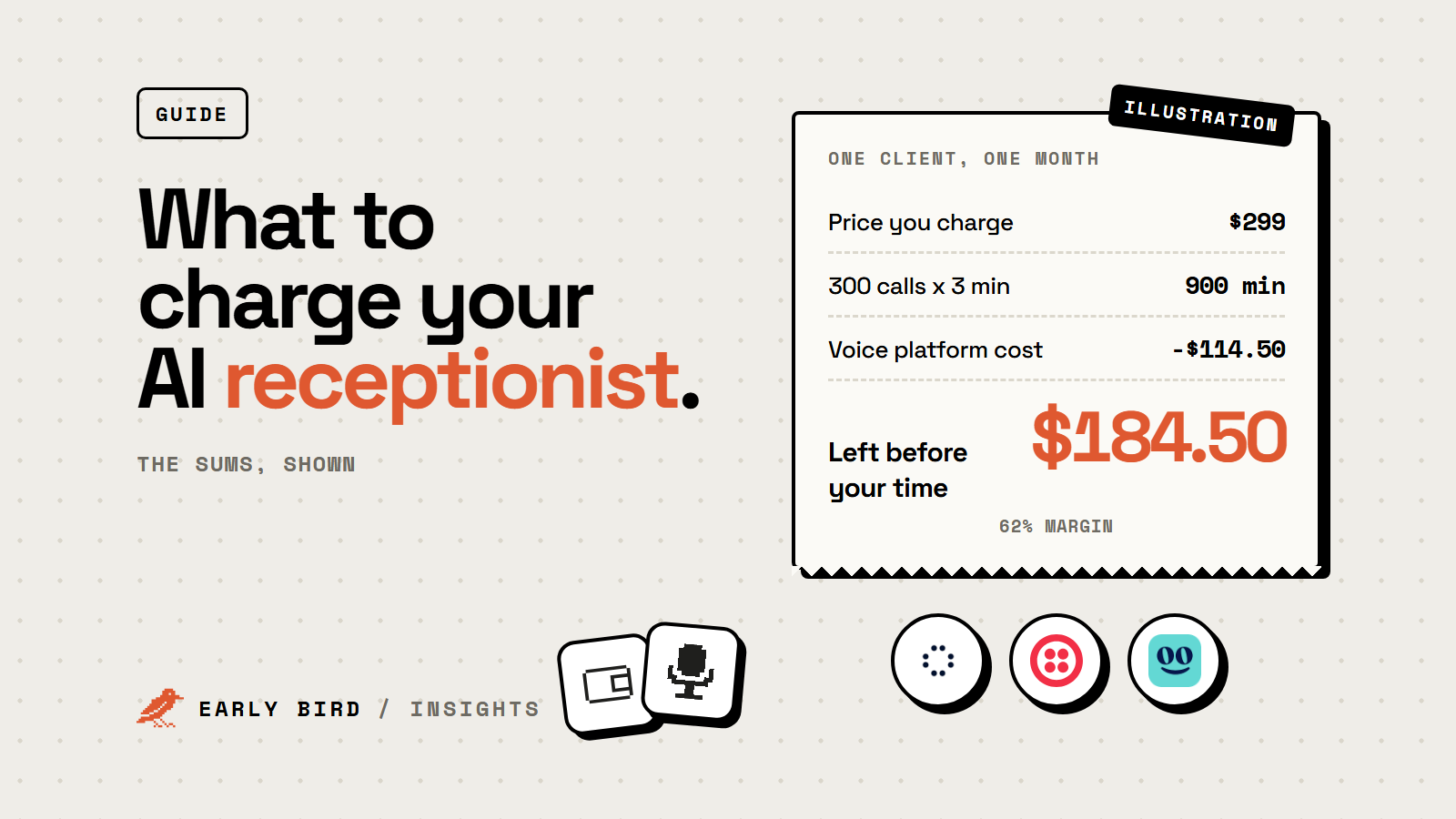
Published AI answering plans in October 2026 run from $79 to $299 a month for small businesses, while human answering services start at $250. The platform behind an AI receptionist costs roughly $0.07 to $0.31 a minute. In our illustration, 300 three-minute calls cost about $114 to run, so a $299 plan leaves roughly $185 before your time and tax.
Key takeaways
- Published self-serve AI answering plans start at $79 a month (Goodcall) and a human answering service starts at $250 for 50 minutes (Ruby), at the time of writing in October 2026.
- Retell AI lists voice agents at $0.07 to $0.31 a minute, with a $10 free credit to test.
- In our worked example, 300 three-minute calls cost about $114.50 a month to run, against a $299 price, a 62% margin before your time.
- If you pick a more expensive language model, the same example costs $222.50 and the margin falls to 26%.
- The 19 AI receptionist ideas on our board have a median potential of $4,500 a month and a median of 3 weeks to a first dollar.
Most pages on AI receptionist pricing list a few vendor plans and stop. If you want to resell one, the real question is the gap between what the platform costs you and what a local business will pay, and almost nobody shows the sums.
The prices below come from each company's own pricing page, read in October 2026. The board figures come from the 19 AI receptionist ideas among the 370 we have researched, explained in how we research. Revenue numbers are our estimates of potential, not earnings. Prices change, so check each page before you quote a client.
What do AI receptionists and answering services charge?
Four published price points give you the market, at the time of writing (October 2026):
| Service | Type | Published price | What it includes |
|---|---|---|---|
| Goodcall Starter | AI, self-serve | $79 a month | 100 unique customers a month, about 150 calls |
| Goodcall Growth | AI, self-serve | $129 a month | 500 unique customers, about 750 calls |
| Goodcall Scale | AI, self-serve | $299 a month | 2,000 unique customers, about 3,000 calls |
| Smith.ai | AI, per call | Free for 25 calls, Pro from $150 | 75 calls on Pro at $2.00 each, falling to $1.67 at 300 calls |
| Ruby | Live humans | $250 a month | 50 minutes, then $395 for 100 and $720 for 200 |
Two things stand out. First, self-serve AI answering is cheap, and Goodcall says it does not meter minutes at all. Second, human answering is far dearer per minute: Ruby's $250 plan for 50 minutes works out at $5 a minute, our arithmetic from its page, and its 500 minute plan at $1,725 is $3.45.
That is the position you are selling into. A business can already buy an AI answering product for under $100 a month, so a reseller needs a reason to charge more, which we come back to below.
What does the platform cost you to run?
If you build the receptionist yourself on a voice platform, you pay per minute of talk. Retell AI, which appears in 13 of the 19 receptionist ideas on our board, lists its voice agents at $0.07 to $0.31 a minute at the time of writing. The cost is built from four parts:
- Voice infrastructure: $0.055 a minute.
- Language model: varies by model, from $0.0016 a minute for a small one to $0.16 for GPT 5.5 and $0.08 for Claude 4.6 Sonnet on the standard tier.
- Speech (the voice itself): $0.015 a minute for Retell's own voices, $0.040 to $0.10 for ElevenLabs voices.
- Phone line: $0.015 a minute for listed countries, and a number costs $2 a month.
There is $10 of free credit, which is enough to build and test one agent. If you bring your own Twilio number, its US page lists $1.15 a month for a local number and $0.0085 a minute for inbound calls.
Worked example: what does one client cost and what do you charge?
This is an illustration, not a quote. We assume a plumber or dental practice that gets 300 calls a month, each lasting three minutes on average. We use Retell's standard-tier figures: $0.055 infrastructure, $0.04 language model (the figure in Retell's own calculator), $0.015 voice and $0.015 phone line.
- Rate per minute: 0.055 + 0.04 + 0.015 + 0.015 = $0.125
- Minutes: 300 calls x 3 minutes = 900
- Usage cost: 900 x $0.125 = $112.50
- Phone number: $2
- Total cost: $114.50 a month
At a price of $299 a month, that leaves $299 minus $114.50, which is $184.50, or 62%, before your time, tax and payment fees.
Now stress it. Swap the language model for the $0.16 option and the per-minute rate becomes 0.055 + 0.16 + 0.015 + 0.015 = $0.245. Then 900 x $0.245 = $220.50, plus $2 is $222.50, and the margin falls to $76.50, or 26%. Longer calls hurt too: at four minutes a call, the base example costs $152 and the margin drops to 49%.
How should you structure the price?
Price in tiers by number of calls, and put the usage limit in writing. Using the same assumptions:
| Tier | Calls a month | Cost to serve | Price | Margin |
|---|---|---|---|---|
| Small | up to 150 | $58.25 | $199 | $140.75 (71%) |
| Standard | up to 300 | $114.50 | $299 | $184.50 (62%) |
| Busy | up to 600 | $227.00 | $499 | $272.00 (55%) |
The margin narrows as volume grows, which is fair, because heavier clients bring more support. These prices are ours, chosen for the illustration, not a recommendation of what the market will bear.
Be honest about the competition. Goodcall's $129 plan covers 500 customers, which is cheaper than our $299 tier for 300 calls. You will not win a price comparison with a self-serve product, so you charge for what it does not do: setting up the booking calendar, writing the greeting in the owner's own words, handling the odd call types of one trade, and checking the calls each month. If you cannot name that extra, you are reselling a commodity.
What do our board numbers say about this model?
The 19 AI receptionist ideas have a median potential of $4,500 a month, the highest among the fast models, and a median of 3 weeks to a first dollar, with none taking longer than 6. All 19 can start for under $500. 12 of the 19 need 5 to 10 hours a week, and 74% list selling as a required skill, which fits with the sums above: the technology is cheap, and the work is persuading a business owner. Only 16% are beginner ideas.
That $4,500 is the size of the opportunity, a number of clients at one price, not what a first client brings in. At $299 a month it would take about 15 clients. Our guide to starting an AI receptionist business covers how to find the first of them, and how to get your first client covers the outreach.
What should you do before you quote a price?
- Build one agent on a free credit and time ten real test calls, so your average call length is measured, not guessed.
- Work out your cost per call using your model, and add a 30% cushion.
- Set tiers with a stated call limit and a price for going over.
- Name your extra: the setup and monthly checking that a self-serve product leaves to the customer.
- Check recording and consent rules in the client's state before you go live.
The 60 second quiz shows whether this model fits your hours and skills. For how this ranks against other AI services, see the best AI side hustles in 2026.
Questions people ask
How much should I charge for an AI receptionist?
Charge by call volume tiers, not by the minute. In our illustration, $199 for up to 150 calls, $299 for up to 300 and $499 for up to 600 all leave a margin of at least 54% over the voice platform cost. Check the tiers against what the self-serve products charge, which start at $79 a month.
How much does it cost to run an AI receptionist?
On Retell AI, the platform costs about $0.125 a minute in our example once the voice, language model and phone minutes are added, and a phone number is $2 a month. A business with 300 three-minute calls a month would cost about $114.50 to serve. A pricier language model can double that.
Is an AI receptionist cheaper than a human answering service?
At the time of writing, yes. Ruby's human plans start at $250 for 50 minutes, which is $5 a minute, while the voice platform behind an AI agent costs about 12.5 cents a minute. A human service may still cope better with unusual calls.
What is the difference between an AI receptionist and a virtual receptionist?
A virtual receptionist, such as Ruby, is a live human answering on your behalf and is billed by the minute. An AI receptionist is software that answers and books calls, and is billed by the call, the customer or the minute depending on the product. The AI version is far cheaper per call, though a human may cope better with unusual calls.
Can I make money reselling an AI receptionist?
Our research suggests the idea can reach a first payment quickly, with a median of 3 weeks. The potential figure of $4,500 a month is our estimate, not a result. The price has to cover the platform costs, your support time and the fact that self-serve rivals are cheaper.