Guides
How to spot a side hustle scam: 10 red flags, each backed by a consumer regulator
The short answer
A side hustle is likely a scam if it asks you to pay first, sells training or a kit as the product, promises big money for little work, says no experience or risk, pressures you to act now, pays for recruiting or stock you cannot sell, or refuses written proof of earnings. These ten red flags come from US Federal Trade Commission guidance.
Key takeaways
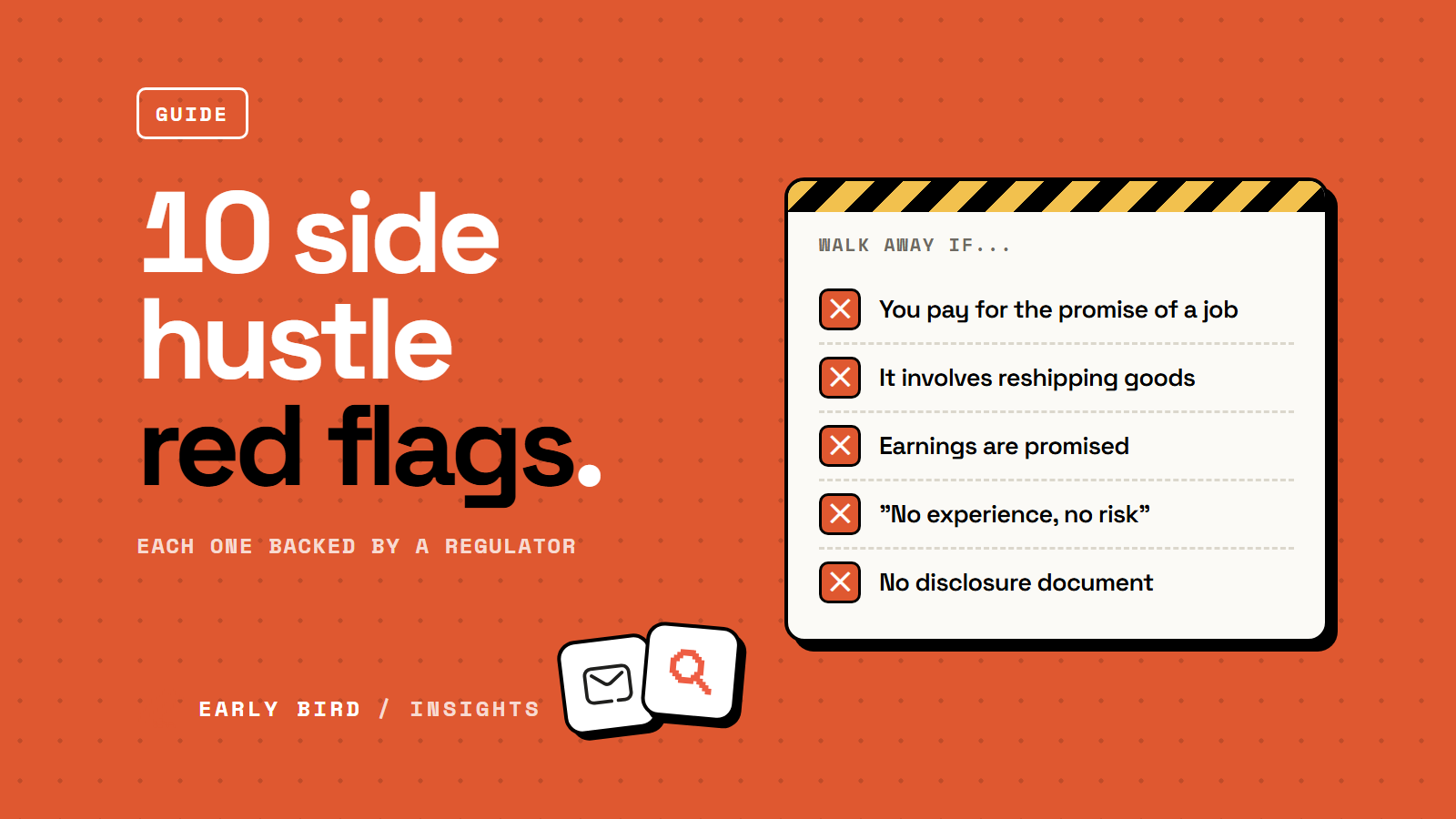
- The US Federal Trade Commission says you should not pay for the promise of a job, and that reshipping goods is never a real job.
- Businesses cannot make false claims about the earnings you can expect, or say that you need no experience or that it is risk-free.
- Under the FTC's Business Opportunity Rule, sellers must give you a disclosure document at least seven days before you sign or pay, with at least 10 references.
- In our own research only 28 of 370 ideas (8%) reach a first dollar within two weeks, and the median is about four to five weeks.
- 74% of the 370 ideas have a potential of $3,000 a month or less, which is a useful yardstick against any bigger promise.
Anyone searching for a side hustle will eventually meet a scam, because the people running them target exactly that search. They do not look like scams. They look like a course, a coach, a "business in a box", or a job offer that arrived by text. The sensible response is to carry a short list of red flags and run every offer against it.
We lean on official sources here, not our own opinion. Each flag below is backed by guidance from the US Federal Trade Commission (FTC), which we fetched and read. The FTC is a US regulator, so its rules apply to sellers in the US, but the questions it recommends work anywhere. Where we use our own board of 370 researched online business ideas as a yardstick, the figures are medians and estimates of potential, not earnings. How we research explains the sums. We name no companies.
What are the 10 red flags?
1. You are asked to pay for the work itself
The FTC's job scam advice is blunt: do not pay for the promise of a job. A placement firm that wants a fee, especially one in advance, is a warning sign. Paying for tools you will use is a separate matter. Paying a person for access to work is the flag.
2. The product is training, a kit or a certificate
The FTC says people end up paying for starter kits, so-called training or certifications that turn out to be useless. If the main thing for sale is the education, ask what a customer of the business, not a student of the course, pays.
3. Big money for little work, quickly
The FTC lists claims that you can make a lot of money in a short period with little work as a sign of a job scam. Measure the claim against reality. In our research, only 28 of 370 ideas (8%) reach a first dollar within two weeks, and the median is about four to five weeks.
4. "No experience needed" or "no risk"
The FTC says businesses cannot make false, misleading or deceptive claims about the earnings you can expect. It also says they cannot misrepresent that you do not need experience, or that buying a money-making opportunity is risk-free or involves little risk. Every real business has risk, and almost all need some skill.
5. Pressure to decide now
The FTC lists a company saying you must act immediately as a warning sign, and advises avoiding companies that discourage you from taking time to study them. A real opportunity will still be there next week.
6. The money comes from recruiting
In the FTC's guidance on pyramid schemes, a warning sign is promoters emphasising recruiting new distributors as the real way to make money. A legitimate business earns from customers who want the product.
7. You must buy stock you cannot use or resell
The FTC warns about distributors buying more products than they want to use or can resell, often to stay in good standing or reach incentives. If your income depends on your own purchases, the customer is you.
8. No written proof, no references, no time to look
Under the FTC's Business Opportunity Rule, a seller must give you a one page disclosure document seven days before you sign or pay. If they make an earnings claim, they must give you a separate document headed "Earnings Claim Statement Required by Law", with the basis for the number. The disclosure must list at least 10 past buyers you can contact. A seller who will not put it in writing is telling you something.
9. A business sale dressed as a job
The FTC's guidance for sellers says not to tell people you are offering them a job if what you are really doing is selling them a business. A job pays you. If a "job" asks you to buy something first, it is a purchase.
10. A cheque arrives and you send money on, or you handle parcels
The FTC says no honest employer will send you a cheque to deposit and then tell you to send on part of the money. The cheque will bounce and you will owe the bank the full amount. It also says reshipping goods is never a real job. A related lure is a call out of the blue from a stranger offering work.
| # | Red flag | Official source |
|---|---|---|
| 1 | Pay for the work itself | FTC, job scams |
| 2 | Training, kit or certificate is the product | FTC, job scams |
| 3 | Big money, little work, fast | FTC, job scams |
| 4 | No experience or no risk | FTC, notice on money-making claims |
| 5 | Pressure to decide now | FTC, notice on money-making claims |
| 6 | Recruiting is the money | FTC, multi-level marketing |
| 7 | Stock you cannot use or resell | FTC, multi-level marketing |
| 8 | No written proof or references | FTC, Business Opportunity Rule |
| 9 | A business sale dressed as a job | FTC, Business Opportunity Rule |
| 10 | Cheque you send on, or reshipping | FTC, job scams |
What do honest numbers look like?
A scam gives you a figure. An honest source gives you a range and says what it is made of. For a yardstick, here are ours. Across 370 researched ideas the median potential is $2,500 a month, and 272 of them (74%) are $3,000 or less. Only 46 (12%) are above $5,000. Those are our estimates of what an idea could make once running, worked out as a number of customers at one price. They are not what anyone has earned.
If an offer's income claim sits well above that, ask what it is built from, and who has actually reached it.
What is a checklist you can run in five minutes?
Run this on any offer before you pay or hand over details:
- Does it want money before work? If so, stop.
- Is the main product training or a kit? Ask who the paying customers are.
- Does it promise big money for little effort, or say no experience and no risk? Treat both as warning signs.
- Is anyone rushing you? Take a week.
- Does income depend on recruiting or on buying stock? Walk away.
- Can you see the earnings evidence in writing, and speak to ten past buyers? If not, assume there is none.
- Did it find you, by call or message, out of the blue? Search for the company yourself.
- Does a cheque arrive, or do you handle parcels? It is a scam.
- Can you search the company's name with the word "complaints"? Do so before you commit.
- Would you still do it if the income claim were halved? If not, you are buying the claim.
What should you do instead?
Start with something cheap enough to lose and slow enough to test. Our data says most ideas cost under $500 and take about a month to a first dollar. See what 370 online business ideas cost and take and how long it takes to make money online for the timelines by model. Choose a business where a paying customer, not a student or a recruit, is the source of the money.
If you want a starting point, the 60 second quiz matches the board to your budget, hours and skills. If you think you have already been caught out, check your own country's consumer protection agency for how to report it.
Questions people ask
How do you spot a side hustle scam?
Look for the pattern, not the pitch. Scams ask you to pay before you earn, sell training or kits as the main product, promise large income for little effort, discourage you from checking, and pressure you to decide now. The FTC lists these as warning signs. Take time, search for the company, and ask for written proof.
Is it normal to pay to start a side hustle?
Paying for tools can be normal, such as a design subscription or a domain. Paying a person for the promise of work is not. The FTC advises not paying for the promise of a job, and a placement firm that wants a fee in advance is a warning sign.
What is the difference between a business opportunity and a job?
A job pays you. A business opportunity asks you to buy something and try to earn it back. The FTC's guidance for sellers says not to tell people you are offering a job if what you are really doing is selling them a business.
What proof of earnings should a seller give you?
In the US, a seller who makes an earnings claim must give you a separate Earnings Claim Statement, with the details behind the number, and a disclosure document with contact details for at least 10 past buyers. Rules differ elsewhere, but the questions are good anywhere: how many people achieved this, and can I speak to them?
Are multi-level marketing and pyramid schemes the same?
No, but they overlap in their warning signs. The FTC says to be wary when promoters make extravagant earnings promises, stress recruiting new distributors as the real way to make money, or push you to buy more products than you can use or resell.
Sources
- Job scams, FTC Consumer Advice
- Multi-level marketing businesses and pyramid schemes, FTC Consumer Advice
- FTC puts over 1,100 businesses on notice about deceptive money-making claims, FTC Consumer Advice
- Selling a work-at-home or other business opportunity? Revised Rule may apply to you, FTC
- Early Bird, how we research online business ideas