News
Custom GPTs are being retired on 11 December 2026. What it means and what replaces them
The short answer
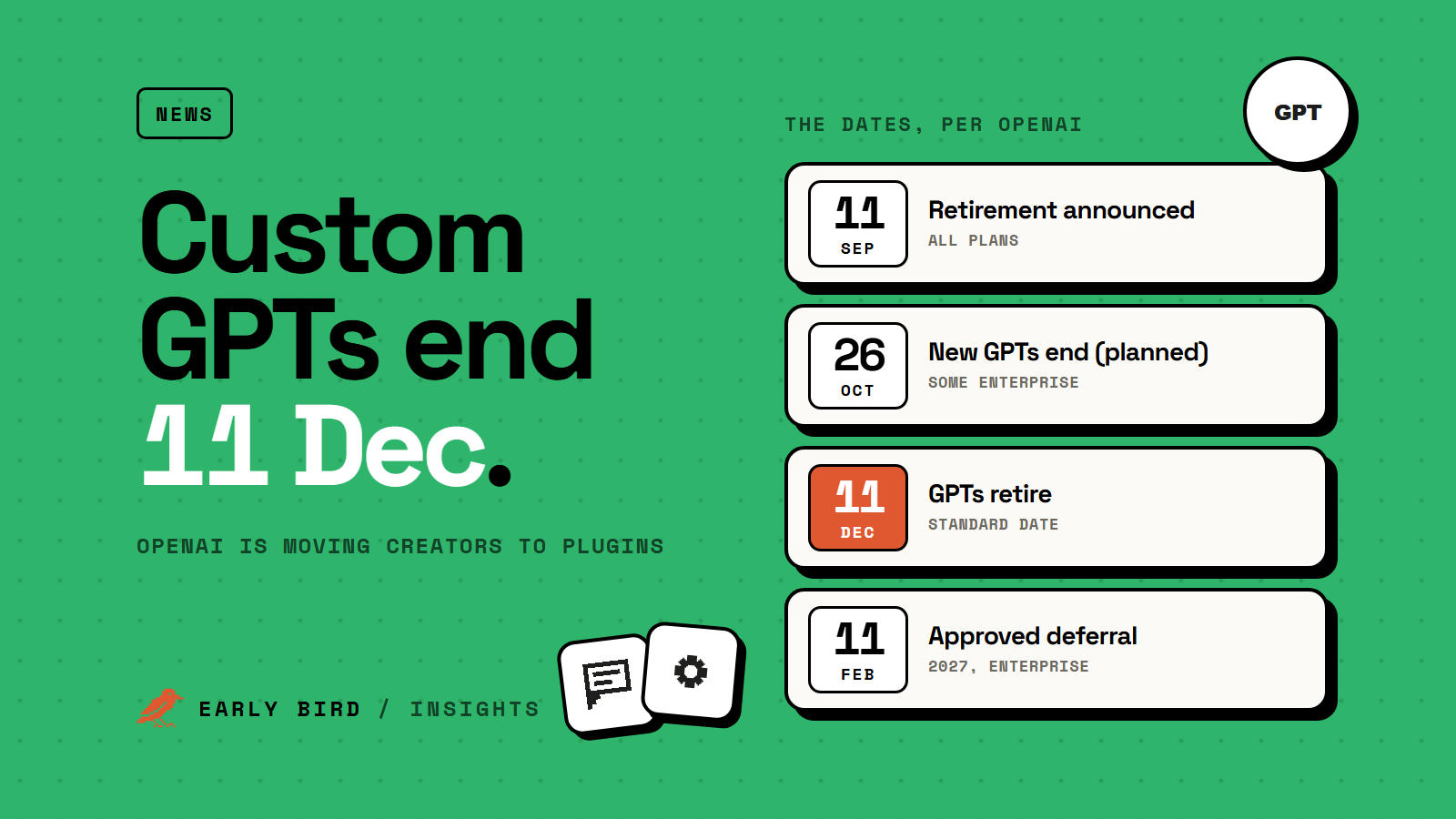
OpenAI has announced it plans to retire custom GPTs on 11 December 2026 and replace them with plugins, which bundle reusable instructions, reference files and connected apps. A GPT's instructions and knowledge files can migrate. Custom actions, the selected model and sharing settings do not, and a migrated plugin starts private. Qualifying Enterprise workspaces may keep GPTs until 11 February 2027.
Key takeaways
- OpenAI's help centre says custom GPTs are scheduled to retire on 11 December 2026, with 11 February 2027 for Enterprise workspaces that have an approved deferral.
- Instructions become a skill and knowledge files become reference files, but custom actions, the selected model and sharing settings do not carry over.
- A migrated plugin starts private, so anyone who used your GPT does not automatically get the replacement.
- 19 of the 370 ideas on our board (5%) are built on custom GPTs, with a median potential of $1,500 a month, against $2,500 for AI automation and vibe coding.
- We have stopped recommending custom GPT ideas while the change settles, and point people to automation and software ideas instead.
If you build or sell custom GPTs, or you were thinking of starting, the ground has moved. OpenAI has announced that it plans to retire them. This piece sets out what the company has actually said, what carries over, what does not, and what it changes for anyone selling this kind of work. It is dated and precise on purpose, because most coverage so far has mixed the confirmed facts with guesses.
The announcement facts come from OpenAI's own help centre and release notes, read on 15 October 2026, plus two trade publications. The board figures come from the 370 ideas on the Early Bird board, and the method is in how we research. Where a date is only planned, we say so.
What has OpenAI announced about custom GPTs?
On 11 September 2026 OpenAI's ChatGPT release notes carried an entry titled "Planned custom GPT retirement and migration to plugins". It says OpenAI is planning to retire custom GPTs across ChatGPT plans and provide a migration path to plugins, which combine reusable instructions with connected apps. Existing GPTs can be used until the retirement date that applies to you.
The dates, from OpenAI's retirement and migration FAQ:
| Date | What happens | Applies to |
|---|---|---|
| 11 September 2026 | Retirement announced, admin notice sent | All plans, Enterprise admins |
| 26 October 2026 (planned) | Creation of new custom GPTs ends | Affected Enterprise workspaces |
| 11 December 2026 | Standard scheduled retirement, GPTs and GPT pages become inaccessible | All plans |
| 11 February 2027 | Retirement for workspaces with a qualified, approved deferral | Some Enterprise workspaces |
OpenAI says the dates are subject to change, and that migration may arrive at different times for different accounts. Visual Studio Magazine, writing on 28 September, and Campus Technology, on 5 October, report the same dates. Both describe the 26 October cutoff as the current Enterprise schedule, not a rule for every account.
What carries over to a plugin, and what does not?
Creators migrate from My GPTs by choosing "Migrate to plugin", once their account has it. OpenAI's FAQ is specific about what moves.
What carries over:
- The GPT's instructions become a skill inside the new plugin.
- Knowledge files are copied into the plugin's reference files.
- Connected apps are added to the plugin as apps.
What does not:
- The selected model.
- Custom actions. They do not transfer through the migration workflow, and rebuilding the connection may need a custom MCP server and technical setup.
- Sharing settings. A migrated plugin starts private, and people who used the original are not given access automatically.
- Drafts. Only the latest published version migrates.
OpenAI also warns that a migrated plugin may respond differently, and tells creators to test familiar prompts before relying on the replacement. Your past conversations with a custom GPT stay accessible after retirement.
What does this mean if you sell custom GPTs?
Three practical things follow from OpenAI's own wording.
The writing survives, the wiring does not. Instructions and reference files move across. Anything that depended on a custom action, such as a GPT that pushed data into a calendar or CRM, has to be rebuilt. Our data shows how common that is: 12 of the 19 custom GPT ideas on the board (63%) use Zapier alongside the GPT.
Distribution resets. A shared link to a GPT does not become a link to the plugin. Creators who handed GPTs to customers will need to re-share, and OpenAI says having access to a public GPT does not mean you will get its replacement.
It is not a like for like swap. Visual Studio Magazine reports builders pushing back in OpenAI's community forum, citing behaviour differences, sharing limits and the loss of the dedicated GPT experience. We have not tested migrations ourselves, so we treat that as reported, not verified.
On money, the pages we read say nothing about payments to plugin creators, and OpenAI's plugin documentation describes publishing to a shared directory for ChatGPT and Codex without mentioning revenue. We would not plan a business on plugin income until that is spelled out.
What does our board say about custom GPT ideas?
Custom GPTs are a small but real slice of what we researched: 19 of 370 ideas, 5%. They were quick and cheap, which is why they looked attractive.
| Model | Ideas | Median potential a month | Median weeks to first dollar | Share needing 10 hours or less | Share needing no coding |
|---|---|---|---|---|---|
| Custom GPT | 19 | $1,500 | 4 | 95% | 100% |
| AI automation service | 46 | $2,500 | 4 | 70% | 98% |
| Vibe-coded tool | 25 | $2,500 | 5 | 32% | 16% |
All 19 custom GPT ideas cost under $500 to start, 14 are services and 5 are software, and 13 name ChatGPT as a tool (no other idea on the board does). Their median potential is the lowest of the three, $1,500 a month, which is an estimate of potential and not anyone's earnings.
Because of the announcement, we have stopped recommending custom GPT ideas and are reviewing the ones already on the board. That is our judgement, not OpenAI's.
What should you build instead?
Build things whose value does not live inside one chat product. Our two nearest neighbours in the data are worth comparing:
- AI automation services. 46 ideas, a median of four weeks to a first dollar, 93% of them listing no-code as the skill needed rather than coding, and Zapier in 74%. The customer pays for a workflow that saves them time, whichever AI sits inside it. See how to start an AI automation agency and whether the market is saturated.
- Vibe-coded tools. 25 ideas, a median of five weeks, but 84% need some coding and only 1 in 25 is a beginner idea. The cost is low and the skill bar is higher. Our guide to making money with vibe coding covers it.
If you already have custom GPTs with paying users, the safe route is dull: migrate one, test it against the same prompts, tell your users the date, and write down which parts relied on custom actions. Keep the instructions and files in a plain document you control, so you can move them again.
What to do before 11 December
- List every GPT you built, who uses it, and which ones use custom actions.
- Publish any draft you need, since only published versions migrate.
- Migrate one and compare answers on five prompts you already trust.
- Give your users the new plugin and confirm they can open it.
- Do not start a new custom GPT business. Take the 60 second quiz and see ideas matched to your budget, hours and skills.
About this article
Everything attributed to OpenAI comes from its help centre, release notes and developer documentation, as read on 15 October 2026, and may change. Trade-press details are labelled as reported. Board figures cover the 370 ideas live on 14 October 2026.
Questions people ask
Are custom GPTs being discontinued?
Yes, OpenAI says it is planning to retire them. Its help centre lists 11 December 2026 as the scheduled retirement date, after which custom GPTs and their pages become inaccessible. Existing GPTs keep working until then, subject to the usual access and workspace permissions.
What replaces custom GPTs?
Plugins. OpenAI describes a plugin as a package that can combine skills, which hold reusable instructions, with reference files and connected apps. Creators migrate from the My GPTs page using a Migrate to plugin option, once it is available on their account.
Do custom GPTs keep working until 11 December?
According to OpenAI, existing GPTs remain usable until the retirement date that applies to you. After you migrate a GPT, the original stays usable but becomes read-only, and you make later changes in the plugin. Enterprise workspaces with an approved deferral have until 11 February 2027.
Can I still sell or share a custom GPT?
Sharing settings do not carry over to a plugin, and a migrated plugin starts private. Making a plugin public needs a separate submission process. OpenAI also says creation of new custom GPTs is planned to end for affected Enterprise workspaces on 26 October 2026, and that timing varies by account.
Should I still build a business on custom GPTs?
We would not start one now. The deliverable, a set of instructions and files, can move to a plugin, but anything that relied on custom actions has to be rebuilt and every user has to be given access again. Services that do not depend on a single chat product are a safer base.
Sources
- Custom GPT retirement and migration FAQ, OpenAI Help Center
- ChatGPT release notes, OpenAI Help Center
- Plugins, OpenAI developer documentation
- OpenAI Discontinuing Custom GPTs and Moving to Plugin Architecture, Campus Technology
- Hands-On With OpenAI's Mandatory Custom GPT-to-Plugin Migration, Visual Studio Magazine
- Early Bird, how we research online business ideas