Opinion
Is the AI automation agency market saturated? An honest look at the evidence
The short answer
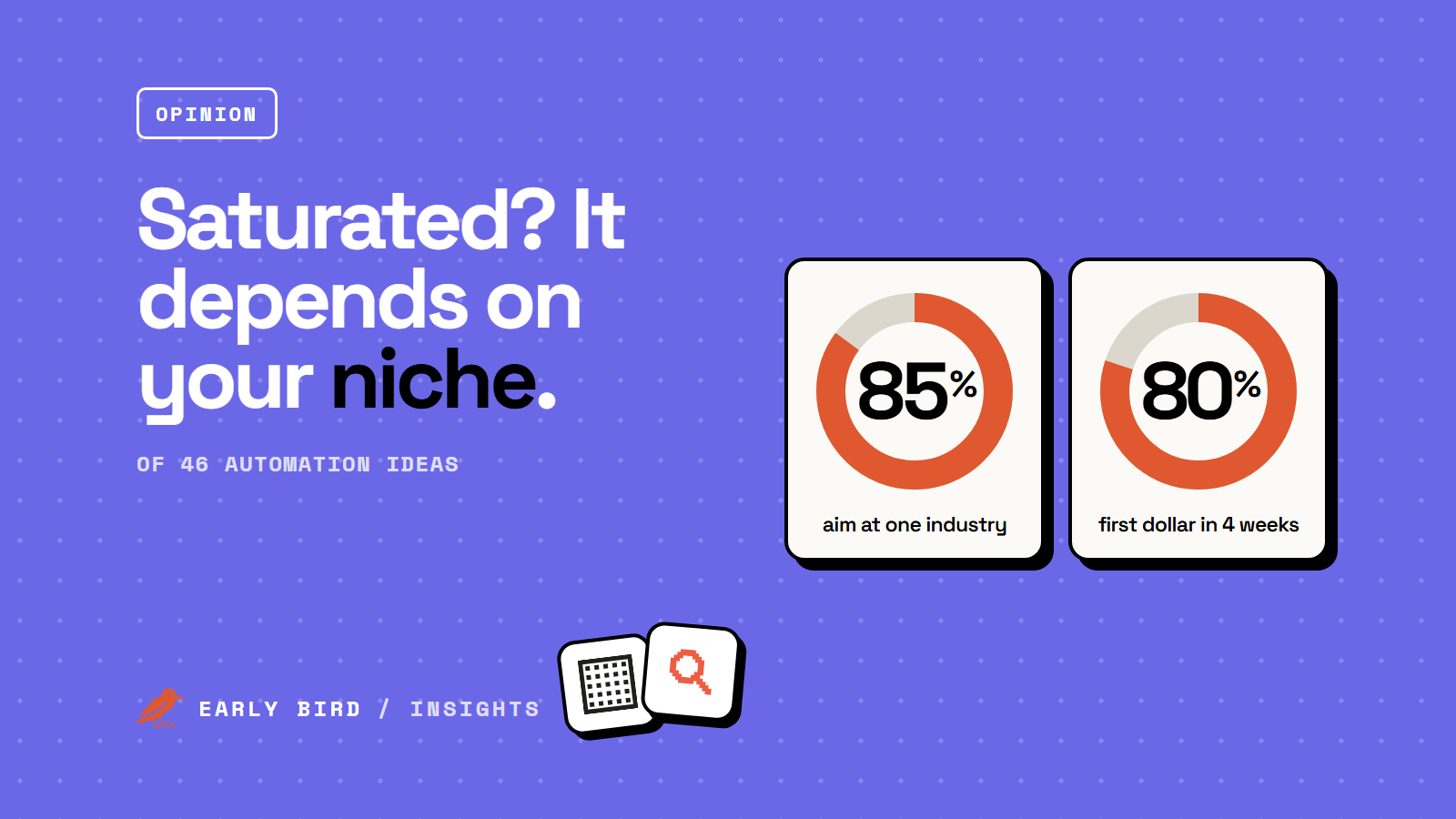
The generic version of the AI automation agency, selling vague AI help to any business, is crowded, because the tools have free plans and the skills are easy to learn. The niche version, one industry and one workflow, is far less so. Of the 46 automation ideas we researched, 85% target one industry, and 80% reach a first dollar within four weeks.
Key takeaways
- We found no reliable count of AI automation agencies, so nobody can honestly give you a saturation percentage, and we will not invent one.
- The tools make it easy to enter: Zapier has a free plan with 100 tasks a month, Make a free plan with 1,000 credits, and n8n a self-hosted version.
- 85% of our 46 automation ideas aim at one industry, and 80% of them reach a first dollar within four weeks.
- Only 11% of the 46 are beginner level and 46% list selling as a skill, so the barrier is business understanding and sales, not software.
- Across the whole board, ideas aimed at a specific industry have a median potential of $2,500 a month against $2,000 for general ones, an estimate, not earnings.
Anyone searching "is the AI automation agency market saturated" is usually asking two things at once: will you be one of thousands doing the same thing, and is there still a way in. The honest answer is that both are true, depending on which version of the business you mean.
Where we can use numbers, they come from the 46 AI automation ideas among the 370 researched ideas on our board, described in how we research. Revenue figures are our estimates of potential, not earnings. Where there is no number to give, we say so, because most of the saturation debate online is opinion from people who sell courses or tools.
Is the market saturated?
We cannot give you a percentage, and be wary of anyone who does. When we searched for a reliable count of AI automation agencies, or a survey of how competitive the field is, we found none. The figures that circulate come from company blogs with no stated method. So we will reason from what we can check instead.
What we can check is how easy it is to start. Zapier lists a free plan with 100 tasks a month. Make lists a free plan with 1,000 credits a month. n8n says a standard self-hosted version is available on GitHub. At the time of writing (October 2026), anyone can build a first working automation for nothing. Easy entry brings in many people, and that is the saturation worth worrying about: a flood of generic sellers competing on price.
Where is it crowded?
At the generic end. If your offer is "we help businesses use AI" or "we build automations for any company", you compete with everyone who completed the same tutorial. The buyer cannot tell you apart, so they ask for a lower price. Three things tend to mark the crowded version, our judgement rather than data:
- A vague offer with no named industry.
- A demo that shows the tool, not the result.
- Pricing by the hour or by the tool, so it is always comparable.
The business owner's problem is the same either way, but they have more reasons to say no.
Where is it not crowded?
Where the offer is narrow enough to be obviously for them. Our board points the same way. Of the 46 AI automation ideas, 39 (85%) are aimed at one specific industry and only 7 at business in general. They spread across 12 of our 13 industries, with trades and the general category the most common at seven each, and 80% reach a first dollar within four weeks.
The industry cut across the whole board is worth a look too:
| Aimed at | Ideas on the board | Median potential a month | Median weeks to first dollar |
|---|---|---|---|
| A specific industry | 312 | $2,500 | 4 |
| Business in general | 58 | $2,000 | 5 |
Across the 46 automation ideas alone the gap is the same direction but small, $2,500 against $2,000, with only 7 general ideas, so we would not lean on it. These are estimates of potential, and the board is a curated sample of ideas we found evidence for, not a census of the market. It cannot prove the niche market is open. It does show that the ideas we judged strongest are the narrow ones.
What does a narrow offer look like?
Here are generic illustrations, not ideas from our board. A plumber loses jobs when calls go unanswered while they are under a sink, so the offer is a text sent to every missed caller within a minute, with a link to book. A dental practice has patients who are overdue a check-up, so the offer is a reminder sequence that runs from the booking system. A letting agent has maintenance requests arriving by email, so the offer is a form that sorts them by urgency and logs each one.
Each is one workflow, one buyer and one number the owner already watches. Compare that with a pitch for AI that streamlines operations. The first can be tested in a week and judged by the owner. The second cannot be judged at all, which is why it gets compared on price.
What does our data not tell us?
Quite a lot, and it is worth saying plainly. The board is ideas we researched, not agencies that exist, so it says nothing about how many people are already selling any of them. The potential figures are estimates worked out as customers at a price. They are not results, and they ignore the months a new agency spends finding its first clients. The speed to a first dollar is our research estimate, and it assumes steady outreach. Treat all of it as evidence about which ideas look strongest on paper, and test the market in your own town before you commit.
Why do the barriers matter more than the numbers?
Because the software is not the hard part. Of the 46 ideas, 93% list no-code skills and only 2% list coding, so the tool is learnable in a few weeks. But only 11% of the ideas are beginner level, and 46% list selling as a required skill. What is scarce is knowing how one type of business actually runs, and being willing to ring up an owner and ask.
That also explains why the generic agency struggles. It has the easy skill, the tool, and lacks the scarce ones, the industry and the sales conversation.
Is it worth it?
It can be, for the right person, and not for everyone. Here is the arithmetic from our guide to starting an AI automation agency: a client paying $250 a month, with a $29.99 tool cost, leaves $220.01. Reaching the $2,500 median potential would take about 10 such clients, since 2,500 divided by 250 is 10, and each needs monitoring time. That is a part-time business with real work in it, not a switch you flip.
It is a worse bet if you want results without selling, if you need income within a fortnight, or if you plan to compete on the cheapest price. It is a better bet if you already know an industry and can name three of its repeated jobs.
How can you test whether your niche is open?
Do this before you buy a course or a tool:
- Search your service, your industry and your region. Count the providers who name that industry. Few means space.
- Ask ten owners whether anyone has pitched them automation this year, and what they said.
- Build one workflow for a business you know, on a free plan, and measure its result.
- Price it as a fixed outcome, not as hours.
The 60 second quiz matches the board to your skills and hours, and how to get your first client covers the conversation. For how this model compares with others, see the best AI side hustles in 2026.
Questions people ask
Is the AI automation agency market saturated?
The generic end is crowded: many people sell a vague promise of AI to any business. The specific end, one industry and one repeated workflow, is much less so. We found no reliable count of agencies, so treat anyone quoting an exact saturation figure with suspicion.
Is an AI automation agency worth it in 2026?
It can be, if you sell one fixed outcome to one type of business. Of the 46 automation ideas we researched, 80% reach a first dollar within four weeks, and the median potential is $2,500 a month, which is our estimate and not a typical result. It is not a beginner business, with only 11% of ideas at that level.
Why do so many AI automation agencies fail?
We have no data on failure rates, so we cannot say how many do. The likely causes are structural: low barriers to entry, vague offers that compete on price, and clients who cancel when the benefit is hard to see. Selling a measurable outcome in one industry addresses all three.
What is the best niche for an AI automation agency?
There is no single best one. Our 46 ideas spread across 12 of our 13 industries, with trades and a general category the most common at 7 each. Pick the industry where you can describe a repeated job, such as a missed call or a late invoice, in the owner's own words.
How do I tell whether my niche is already crowded?
Search for your service plus your industry and your region, and note how many specific providers appear. Then ask ten owners whether anyone has pitched them this year. If there are none, the niche is open. If every owner has had five pitches, you need a sharper angle.